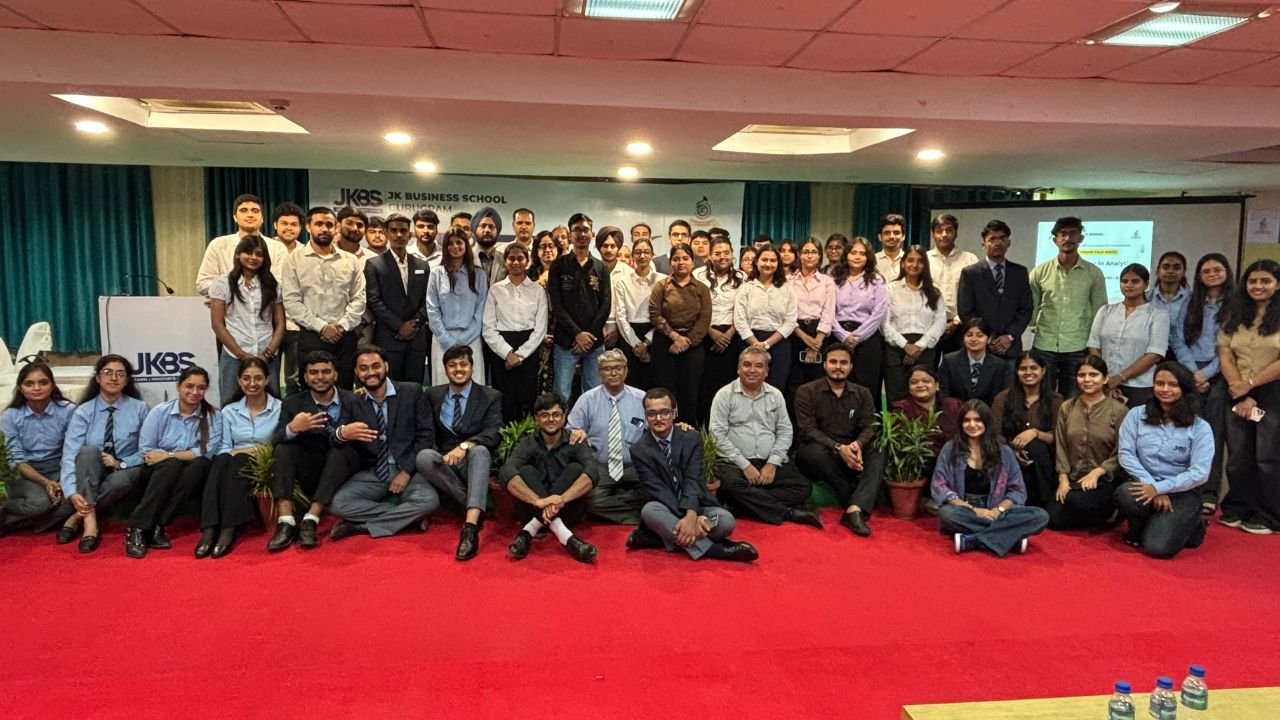
Every year on 5 September, India celebrates Teachers’ Day to recognise the contribution educators make to individuals, institutions and society. The occasion commemorates the birth anniversary of Dr. Sarvepalli Radhakrishnan, India’s second President, distinguished philosopher and respected educator, who was born on 5 September 1888.
Teachers’ Day is more than a ceremonial occasion. It is an opportunity to recognise the people who encourage curiosity, challenge assumptions, build confidence and help students discover what they are capable of achieving.
At JK Business School, Gurugram (JKBS), this idea carries particular significance. Management education is not limited to textbooks, presentations or examinations. It is shaped by conversations, case discussions, projects, feedback, industry perspectives and, most importantly, mentorship.
For students pursuing PGDM and BBA programmes, faculty members play an important role in connecting academic concepts with the realities of business and professional life.
Why Teachers’ Day Matters in Management Education
Management education has a distinctive purpose. Students are not only expected to understand business concepts but also to learn how to apply them when situations are uncertain, information is incomplete and multiple perspectives need to be considered.
A textbook can explain leadership. A classroom discussion can make students question what effective leadership actually looks like.
A finance course can introduce analytical frameworks. A faculty mentor can help students understand how those frameworks influence real business decisions.
Marketing theories can explain consumer behaviour, but discussions around contemporary markets can encourage students to think about why consumers behave differently across contexts.
This is where the role of a teacher extends beyond instruction.
Effective management educators help students develop the ability to analyse, question, communicate, collaborate and make decisions. These capabilities become increasingly important as students move from classrooms to internships and eventually into professional environments.
From Teaching to Mentorship
There is an important difference between delivering information and mentoring a student.
Teaching introduces concepts. Mentorship helps students understand how those concepts connect with their aspirations, strengths and future responsibilities.
At JK Business School, Gurugram, faculty engagement forms an important part of the student learning experience.
Mentors can help students navigate academic challenges, identify areas where they need improvement and develop greater clarity about their professional direction.
Sometimes mentorship takes place during a formal academic discussion. At other times, it can be a conversation after class, feedback on a presentation or a suggestion that encourages a student to approach a problem differently.
These interactions may appear small at the time, but they can leave a lasting impact.
Bridging Classroom Concepts and Business Realities
One of the most valuable roles of a management educator is helping students understand the connection between theory and practice.
Business environments are constantly evolving. Technology is transforming operations, artificial intelligence is influencing decision making, data is becoming increasingly important across functions and organizations are responding to changing customer expectations.
Students therefore need more than conceptual knowledge.
Faculty members help create this connection through case-based learning, practical discussions, live projects, internships and industry-oriented activities.
A classroom case may require students to evaluate competing business choices. A project may challenge them to work with deadlines and team dynamics. An internship may expose them to workplace expectations for the first time.
Faculty guidance helps students reflect on these experiences and convert them into meaningful learning.
Helping Students Learn to Think Independently
A good management classroom does not always provide one correct answer.
Business decisions often involve trade-offs. A strategy that works for one organization may not work for another. A marketing campaign may succeed with one audience and fail with another. A financial decision that appears attractive in the short term may create different consequences over time.
Students therefore need to develop the ability to evaluate information independently.
Faculty members play an important role in encouraging this habit.
Instead of simply asking students to remember concepts, management education can challenge them to ask:
- Why does this happen?
- What evidence supports this decision?
- What are the alternatives?
- Who will be affected?
- What could go wrong?
- Is there another perspective?
These questions gradually develop critical thinking and decision-making ability, skills that students can carry into their professional lives.
The Teacher Behind Every Confident Student
Confidence in business school is rarely built overnight.
For some students, speaking during a classroom discussion may initially feel difficult. Others may hesitate during presentations, interviews or group activities.
Consistent faculty feedback can make a significant difference.
A teacher who encourages a student to speak again after an imperfect presentation is doing more than correcting communication skills. A mentor who asks a student to reconsider an argument is developing critical thinking. A faculty member who provides constructive feedback on a project is helping the student become more comfortable with professional evaluation.
Over time, these experiences contribute to confidence.
This is why the impact of an educator cannot always be measured through marks or academic results alone. Sometimes it becomes visible years later in the way a former student communicates, solves problems, manages a team or handles responsibility.
Mentorship During Internships and Live Projects
The transition from academic learning to practical application is an important stage of management education.
Internships and live projects expose students to situations where expectations are different from those in a classroom.
Deadlines become real. Team coordination matters. Communication has consequences. Students may encounter problems for which there is no predefined solution.
Faculty mentorship can help students navigate this transition.
Before an internship, a mentor may help a student understand professional expectations. During a project, faculty guidance may encourage students to examine an issue more deeply. After the experience, reflection can help students identify what they learned and where they need to improve.
The objective is not simply to complete an internship or project. It is to turn the experience into professional learning.
Teachers as Career Guides
For many students, business school is also a period of significant career exploration.
A student may enter with an interest in marketing and later discover an aptitude for analytics. Another may initially prefer finance but develop an interest in operations or entrepreneurship.
Faculty members can become valuable sounding boards during this process.
Their understanding of a student’s academic performance, interests and working style can help make career conversations more meaningful.
Career guidance in this context goes beyond securing a placement. It can help students think about the type of work they enjoy, the skills they need to strengthen and the professional direction that fits their capabilities.
The best career advice does not simply tell students where to go. It helps them understand themselves well enough to make informed choices.
Learning Values Alongside Management Skills
Business education is also about responsibility.
Future managers and business leaders will make decisions that affect employees, customers, organizations and communities. Technical competence matters, but so do integrity, empathy and accountability.
Teachers contribute to this dimension of learning as well.
The way a faculty member approaches a discussion, evaluates competing viewpoints or responds to disagreement can itself become a lesson in professional conduct.
Students observe not only what teachers say but also how they think and behave.
For this reason, mentorship can influence both competence and character.
Faculty and the Culture of Lifelong Learning
Teachers also demonstrate something that is particularly important in contemporary business: learning never really ends.
Markets evolve. Technologies change. New research challenges established ideas. Skills that are relevant today may need to be updated tomorrow.
Faculty members who engage with research, industry developments and emerging business practices demonstrate the importance of staying intellectually curious.
For students, this is an important lesson.
Graduating from business school should not mark the end of learning. It should provide the foundation for a career in which learning becomes continuous.
This mindset is especially relevant as areas such as artificial intelligence, digital transformation, business analytics and sustainability reshape professional roles.
A Teacher’s Influence Often Extends Beyond Campus
Students may eventually forget the exact details of a lecture, but they often remember the teacher who helped them see a problem differently.
They remember the person who encouraged them before an interview, challenged them during a presentation, recommended a book, helped them improve a project or simply listened when they needed guidance.
This is what makes the teacher-student relationship so important.
The impact often extends beyond the duration of a programme. Lessons learned through mentorship can influence how graduates approach colleagues, lead teams and respond to professional challenges years later.
A Moment to Say Thank You
Teachers’ Day offers students and alumni an opportunity to recognise these contributions.
Gratitude does not need to be elaborate. A short message, a phone call or a simple thank you can acknowledge the influence an educator has had on someone’s journey.
For current students, the occasion is also a reminder to value the mentorship available during their time on campus.
Ask questions. Seek feedback. Participate in discussions. Speak with faculty members about ideas that interest you. Learn from their academic knowledge and professional perspectives.
The value of business school increases when students actively engage with the people who teach and mentor them.
Shaping Tomorrow’s Leaders Through Purposeful Teaching
As JK Business School, Gurugram continues its journey in management education through its PGDM and BBA programmes, the faculty-student relationship remains central to the learning experience.
Classrooms provide knowledge. Projects provide practice. Industry exposure provides perspective. Mentorship connects them all.
Teachers help students move from knowing concepts to understanding their application, from hesitating to participating and from following instructions to thinking independently.
That transformation is difficult to capture in a textbook, but it is at the heart of meaningful education.
On Teachers’ Day, JK Business School, Gurugram recognises educators whose contribution extends beyond lessons and lectures. Their guidance helps students develop knowledge, confidence, values and the ability to approach their future responsibilities with greater purpose.
Happy Teachers’ Day to the educators who make learning meaningful and help shape the business leaders of tomorrow.