Written By : Shahana Qutab (Assistant Professor Marketing, JKBS)
You studied hard. You cleared your exams. You earned decent grades.
And yet, six months into your first job, you are struggling — not because you lack knowledge, but because nobody taught you how to lead a meeting, manage a difficult teammate, or stay calm when a deadline collapses.
If this sounds familiar, you are not alone. According to a LinkedIn Workplace Learning Report, 89% of hiring failures are caused by a lack of soft skills — not technical knowledge. Yet most students spend their entire academic lives optimising for the one thing that predicts career success the least: their marksheet.
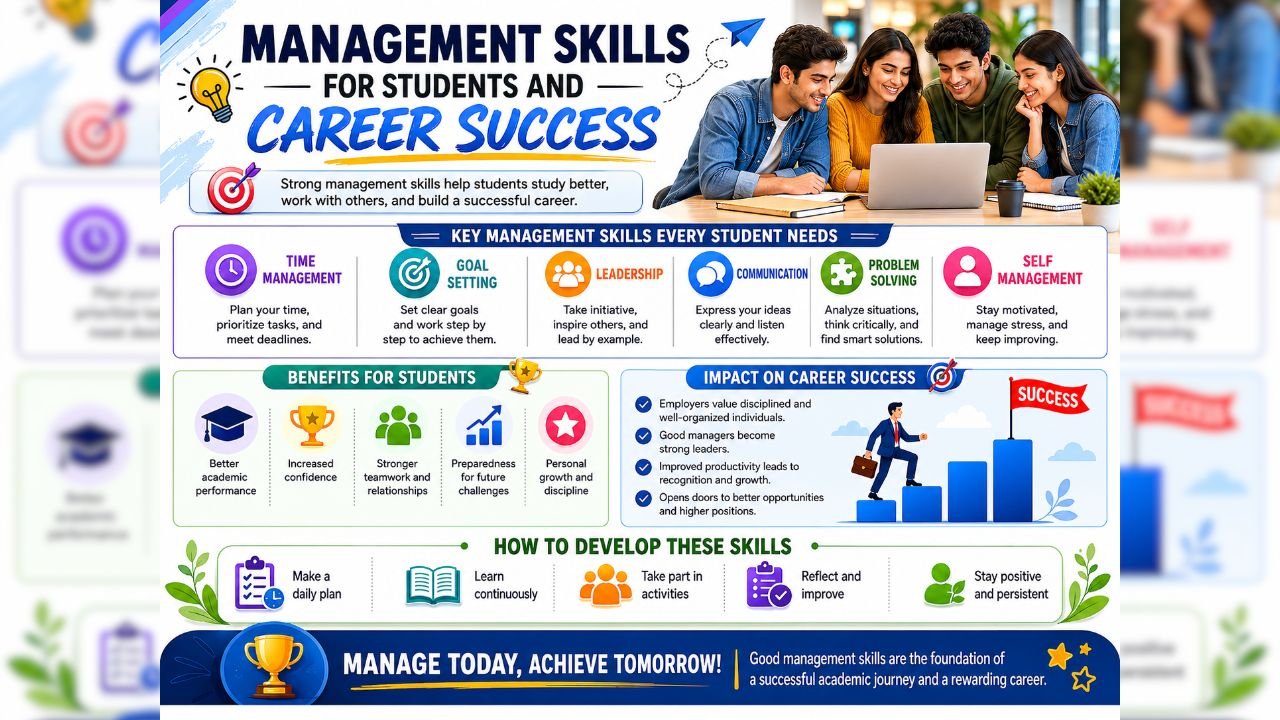
The real differentiator in today’s workplace is a set of practical management skills for students — leadership, emotional intelligence, communication, adaptability, and strategic thinking — that schools rarely teach explicitly but employers demand from day one.
This article breaks down exactly what those skills are, why they matter more than your GPA, and how you can start building them today.
Why Your Marksheet Is Not Your Career Plan
Grades measure how well you recall and reproduce information under examination conditions. They do not measure how you perform under pressure, how you motivate a disengaged team, or how you navigate an ambiguous business decision — which is, incidentally, what managers do every single day.
Research from the National Association of Colleges and Employers (NACE) consistently shows that employers rank communication, teamwork, problem-solving, and leadership as their top hiring criteria — far above academic GPA. McKinsey’s Future of Work research further highlights that demand for social and emotional skills will grow by 26% through 2030, even as automation replaces routine cognitive tasks.
In India specifically, the gap is striking. A 2023 India Skills Report found that only 45% of graduating students are considered employable by industry standards — despite academic qualifications. The deficit is overwhelmingly in workplace-ready competencies, not subject knowledge.
The conclusion is uncomfortable but clear: grades get you shortlisted. Management skills get you hired, promoted, and respected.
Proof from the Top: Indian Leaders Who Built Empires on Skills, Not Scores
Before exploring the skills themselves, it is worth anchoring this conversation in reality — specifically, Indian reality.
Ratan Tata: Quiet Leadership, Extraordinary Legacy
Ratan Tata was not a classroom superstar. What set him apart was his ability to listen deeply, earn trust across cultures, and make long-term decisions that prioritised people alongside profit. He acquired Jaguar Land Rover during the 2008 financial crisis — a move widely criticised at the time — and turned it into one of the Tata Group’s most profitable assets. That is strategic thinking and resilience in action.
Narayana Murthy: Building Culture Before It Was Trendy
Infosys co-founder N.R. Narayana Murthy built one of India’s most iconic companies not on technical genius alone, but on an unwavering commitment to ethical leadership, team culture, and communication. He famously started Infosys with Rs. 10,000 borrowed from his wife — and scaled it into a global IT powerhouse through clarity of vision and people management.
Kiran Mazumdar-Shaw: Resilience as a Business Strategy
Biocon’s founder faced consistent rejection early in her career — banks refused loans, partners backed out, and the industry was dismissive of a woman entrepreneur in a science-heavy field. She built India’s largest biopharmaceuticals company anyway. Her career is a masterclass in adaptability, emotional regulation, and the refusal to define herself by external setbacks.
The 7 Most Critical Management Skills for Students in 2026
Not all skills are equal. These seven have the highest career ROI for students entering the workforce or pursuing postgraduate management education.
1. Leadership — The Ability to Move People
Leadership is not a title. It is the ability to influence others toward a shared goal — even without formal authority. Students who lead clubs, organise events, or take charge of group projects are already practising it.
How to build it: Volunteer for leadership roles in college committees. Seek feedback from peers. Study leadership failures as much as successes.
2. Communication — The Skill That Pays Every Day
Poor communication is the single most common complaint managers have about new hires. It is not about speaking fluently — it is about conveying the right message to the right person in the right way, whether in a boardroom presentation, a Slack message, or a difficult one-on-one conversation.
How to build it: Practice structured speaking (join a debate club or toastmasters group). Write daily — even short reflections sharpen clarity. Seek opportunities to present in front of audiences.
3. Emotional Intelligence — The Hidden Multiplier
Emotional intelligence in management is the ability to recognise, understand, and manage both your own emotions and those of the people around you. Research by psychologist Daniel Goleman found that EQ accounts for nearly 90% of the difference between average and star performers in leadership roles.
High EQ managers do not just avoid conflict — they turn tension into productive dialogue. They do not just meet targets — they build teams that want to exceed them.
How to build it: Practice active listening. Keep a journal to reflect on emotional reactions. Seek diverse peer groups that challenge your assumptions.
4. Problem-Solving and Decision-Making
Every manager’s day is a series of decisions — small, medium, and high-stakes. The students who stand out are not those with the right answers ready, but those who have a clear process for finding them: defining the problem accurately, evaluating options systematically, and committing to a course of action under uncertainty.
How to build it: Engage with real business case studies. Use frameworks like SWOT, root-cause analysis, and decision matrices. Participate in competitions like B-school case challenges.
5. Teamwork and Collaboration
Modern organisations run on cross-functional teams. The ability to contribute meaningfully in a group — managing disagreements, distributing work fairly, and holding yourself accountable — is essential long before you ever manage people directly.
How to build it: Intentionally work with people different from you. Reflect after every group project on what you contributed and what you could improve. Learn to give and receive constructive feedback.
6. Adaptability and Resilience
The World Economic Forum’s Future of Jobs Report identifies adaptability as one of the top three skills employers will prioritise through 2027. Industries are being disrupted faster than ever. The students who thrive will be those who treat change as a signal to learn rather than a threat to avoid.
How to build it: Put yourself in unfamiliar environments regularly. Take on projects outside your comfort zone. When things go wrong, analyse the failure before moving on.
7. Strategic Thinking
Strategic thinking is the ability to see beyond the immediate task — to understand how decisions connect, how markets shift, and where opportunities will emerge. It is what separates executors from leaders.
How to build it: Read business news daily (Economic Times, Mint, HBR). Analyse companies you admire. Ask “why” more than you ask “what”.
How JK Business School Builds These Skills into Every PGDM Student
At JK Business School (JKBS), Gurugram, we recognised years ago that classroom learning alone cannot produce industry-ready managers. The gap between academic performance and workplace readiness is not a student problem — it is a curriculum design problem.
That is why our PGDM programme is structured around four pillars of experiential learning:
- Live Industry Projects: Students work on real briefs from real companies, developing problem-solving and strategic thinking in actual business contexts — not simulated ones.
- Corporate Mentoring: Every student is paired with a senior industry professional who provides career guidance, perspective, and accountability through the programme.
- Leadership Immersion Activities: Structured workshops, cross-batch collaboration exercises, and leadership simulations build practical team and communication skills.
- Mandatory Internships: Students spend time inside organisations before graduation, applying classroom frameworks to real teams and real pressures.
The goal is not to produce graduates with impressive CVs. It is to produce managers who can walk into a room on day one and immediately contribute — because they have done it before.
Frequently Asked Questions
Are management skills more important than grades for getting a job?
For entry-level roles, grades often serve as an initial filter. But beyond the shortlist, hiring decisions are driven almost entirely by how candidates communicate, think through problems, and demonstrate leadership potential. For mid-level and senior roles, grades become essentially irrelevant.
Can management skills be learned, or are they innate?
They can absolutely be learned — and must be practised. Emotional intelligence, communication, leadership, and strategic thinking are all skill sets that develop through deliberate effort, feedback, and real-world application. Research consistently shows that these competencies are more trainable than raw intelligence.
What is the best way for students to develop leadership skills in college?
The fastest path is deliberate exposure: take on roles that require you to coordinate others, make decisions with incomplete information, and deal with disagreement. College clubs, student council, event organising, and group project leadership all work. The key is to reflect actively on each experience — what worked, what did not, and why.
How does PGDM help develop management skills?
A well-designed PGDM programme does not just teach business theory — it puts you inside real-world business scenarios. Case studies, live projects, internships, and corporate mentoring are all structured to force the application of management skills in contexts that mirror what you will face in your career.
Conclusion: Grades Open Doors. Skills Build Careers.
The most successful managers and entrepreneurs in the world are not necessarily the people who scored highest in school. They are the people who learned how to lead under pressure, communicate with clarity, adapt when plans changed, and inspire others to do their best work.
Academic performance matters — it signals discipline and commitment. But it is only the starting line. The race itself is won by management skills for students that are rarely tested in examinations but tested every single day in the workplace.
Start building these skills now. Not after admission. Not after graduation. Now — because every project, every difficult conversation, and every setback you navigate in college is an opportunity to become the kind of leader organisations will compete to hire.
Ready to build real management skills before you graduate?
Explore JKBS’s PGDM programme — designed to develop industry-ready managers through live projects, corporate mentoring, and experiential learning.
Visit: www.jkbschool.org/ | Apply: apply.jkbschool.org