Academic research plays a vital role in shaping the future of industries and public policy. By examining emerging challenges and opportunities, researchers help organizations and regulators understand how to adapt to changing economic and social environments.
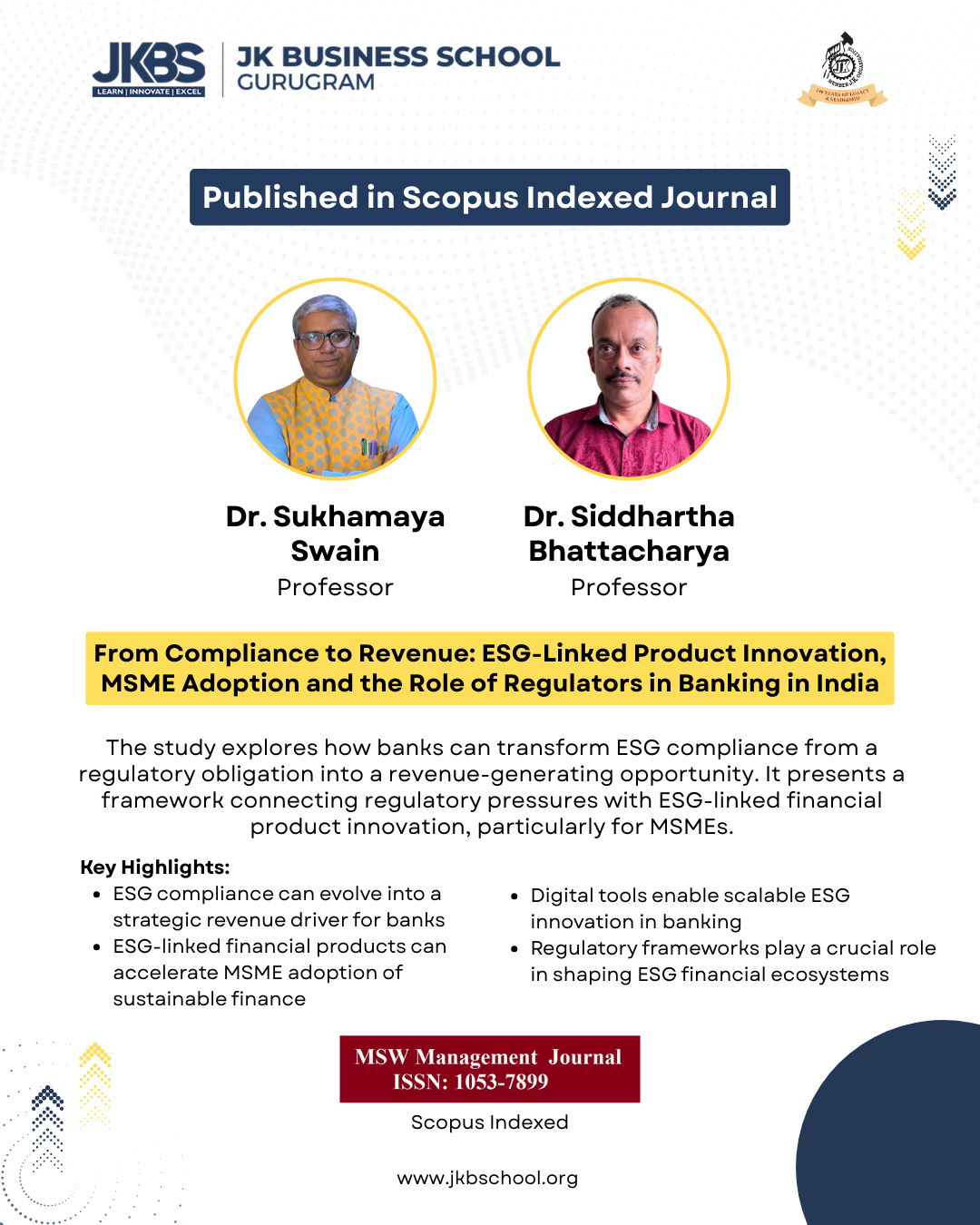
In a recent academic contribution, Dr. Sukhamaya Swain and Dr. Siddhartha Bhattacharya from JK Business School, Gurugram, have published a research paper titled From Compliance to Revenue: ESG Linked Product Innovation, MSME Adoption and the Role of Regulators in Banking in India.
The research has been published in the MSW Management Journal (ISSN: 1053-7899), a Scopus indexed journal, highlighting the growing academic engagement of JK Business School faculty in areas that are highly relevant to global economic transformation.
The study examines how sustainability principles, technological innovation, and regulatory frameworks can work together to reshape modern banking systems, particularly in the context of India’s rapidly evolving financial landscape.
Understanding ESG in the Banking Sector
Environmental, Social, and Governance principles, commonly referred to as ESG, have become central to discussions about sustainable economic development.
Financial institutions across the world are increasingly integrating ESG considerations into their business strategies. Investors, regulators, and consumers are demanding greater transparency and responsibility from organizations regarding their environmental and social impact.
Banks play a crucial role in this transformation. Through lending decisions, investment policies, and financial products, banks influence how capital flows across different sectors of the economy.
The research conducted by Dr. Sukhamaya Swain and Dr. Siddhartha Bhattacharya explores how Indian banks can move beyond viewing ESG merely as a compliance requirement and instead treat it as a strategic opportunity for innovation and revenue generation.
From Regulatory Compliance to Strategic Opportunity
Traditionally, ESG initiatives in banking have often been driven by regulatory requirements. Financial institutions were expected to follow sustainability guidelines primarily to meet compliance standards.
However, the research suggests that banks can adopt a more proactive approach by developing ESG linked financial products that create value for both institutions and their clients.
Instead of viewing sustainability obligations as regulatory burdens, banks can use ESG frameworks to design innovative financial instruments that support environmentally responsible and socially beneficial business activities.
This shift from compliance to innovation represents a major opportunity for the banking sector.
By introducing products that encourage sustainable practices, banks can simultaneously contribute to environmental goals while generating new revenue streams.
ESG Linked Financial Products in Banking
One of the key insights of the research is the growing importance of ESG linked financial products.
These products integrate sustainability metrics into financial agreements, allowing borrowers and financial institutions to align economic performance with environmental and social objectives.
Examples of such financial products include:
- green loans that support environmentally sustainable projects
- sustainability linked credit facilities
- ESG based investment funds
- financing solutions that encourage energy efficiency and responsible production practices
These financial instruments help organizations adopt sustainable practices while maintaining access to capital.
The research highlights how the development of such products can strengthen the relationship between financial institutions and businesses that are committed to sustainable growth.
The Role of MSMEs in Sustainable Finance
Micro, Small, and Medium Enterprises play a critical role in the Indian economy. They contribute significantly to employment generation, industrial output, and economic development.
However, many MSMEs face challenges when adopting sustainable practices due to limited access to finance, technological resources, and regulatory guidance.
The research emphasizes that banks can support MSMEs by designing financial products specifically tailored to encourage sustainable business practices.
For example, sustainability linked loans can provide financial incentives for MSMEs that adopt environmentally responsible production methods or improve energy efficiency.
Such initiatives help bridge the gap between financial inclusion and sustainable development.
By supporting MSMEs in their sustainability journey, banks can contribute to broader economic resilience while also expanding their own customer base.
Digital Transformation and Sustainable Finance
Another important dimension of the research focuses on the role of digital technologies in promoting sustainable finance.
Digital tools such as data analytics platforms, fintech solutions, and automated reporting systems enable banks to track sustainability metrics more effectively.
These technologies allow financial institutions to evaluate ESG performance, monitor compliance with sustainability criteria, and assess the environmental impact of financial activities.
Digital innovation therefore strengthens the ability of banks to design and manage ESG linked financial products.
In the Indian context, where fintech adoption is rapidly expanding, digital platforms can play a significant role in accelerating sustainable finance adoption.
The integration of digital technologies with ESG frameworks creates opportunities for banks to enhance transparency, improve risk management, and support sustainable economic development.
The Role of Regulators in ESG Adoption
The research also highlights the critical role of regulators in encouraging sustainable finance practices within the banking sector.
Regulatory institutions influence how banks adopt ESG principles by establishing policy guidelines, reporting standards, and financial incentives.
Clear regulatory frameworks help financial institutions integrate sustainability into their business strategies while maintaining financial stability.
Regulators can also encourage innovation by supporting the development of ESG linked financial products and promoting transparency in sustainability reporting.
In India, regulatory authorities have increasingly emphasized sustainable finance initiatives, encouraging banks to align their operations with environmental and social goals.
The research suggests that effective collaboration between regulators, financial institutions, and businesses is essential for building a robust sustainable finance ecosystem.
Implications for the Future of Banking
The findings of the study have significant implications for the future of the banking industry.
As sustainability becomes a global priority, financial institutions will play an increasingly important role in supporting environmentally responsible economic growth.
Banks that integrate ESG principles into their business strategies are likely to gain competitive advantages in several areas.
These advantages include:
- improved risk management
- enhanced brand reputation
- stronger relationships with socially responsible investors
- access to new market opportunities related to sustainable finance
By adopting ESG linked financial products, banks can align profitability with sustainability goals while supporting broader economic development.
Academic Research at JK Business School Gurugram
The publication of this research reflects the growing academic engagement of faculty members at JK Business School, Gurugram in addressing real world economic and policy challenges.
Research initiatives at the institution focus on topics that have practical relevance for industry, policy makers, and society.
By contributing to international academic journals, faculty members help expand knowledge in areas such as finance, sustainability, digital transformation, and management innovation.
The research work of Dr. Sukhamaya Swain and Dr. Siddhartha Bhattacharya demonstrates how academic insights can support meaningful dialogue between researchers, regulators, and financial institutions.
Such contributions reinforce the role of JK Business School as a center for intellectual inquiry and thought leadership in management education.
Read the Full Research Paper
Readers who are interested in exploring the research in greater detail can access the full paper through the official publication link.
Research Paper: From Compliance to Revenue: ESG Linked Product Innovation, MSME Adoption and the Role of Regulators in Banking in India
Available at Click Here
Advancing Sustainable Finance Through Research
Sustainable finance is rapidly becoming one of the most important areas of global economic policy. Financial institutions are increasingly expected to balance profitability with social and environmental responsibility.
Research such as this provides valuable insights into how banks can integrate sustainability into their business strategies while supporting economic development.
Through academic contributions like this, JK Business School, Gurugram continues to strengthen its commitment to research excellence and industry relevance.
By examining emerging challenges and opportunities in fields such as sustainable finance and ESG innovation, the institution contributes to shaping conversations that influence the future of business and society.