The global financial landscape is undergoing a significant transformation driven by rapid technological advancements and the increasing adoption of digital systems. One of the most important developments in this space is the emergence of Central Bank Digital Currencies, commonly referred to as CBDCs.
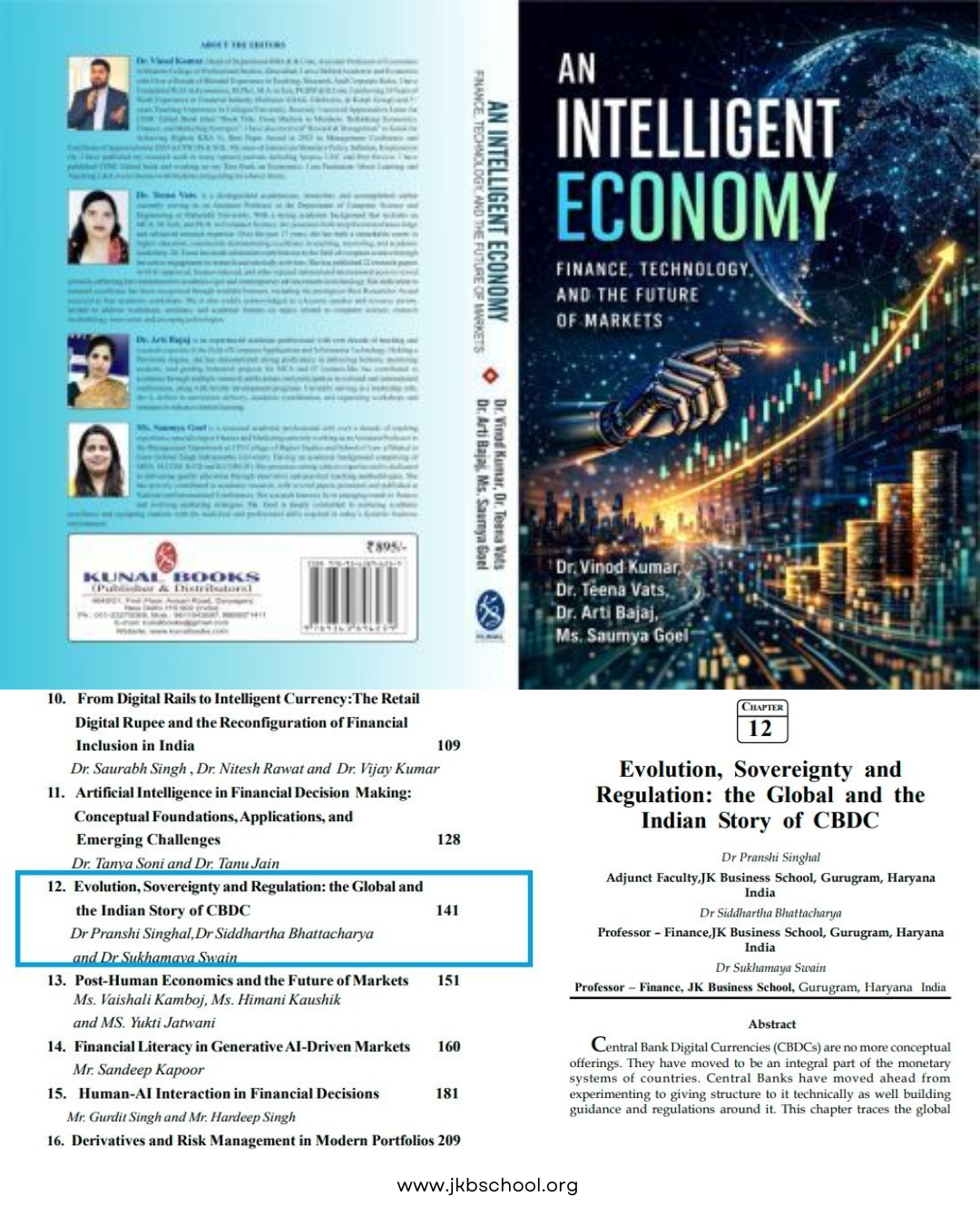
In line with this evolving financial ecosystem, faculty members from JK Business School, Gurugram have contributed to a significant academic publication that explores the future of digital finance. A book chapter titled “Evolution, Sovereignty and Regulation: The Global and the Indian Story of CBDC” has been published in the book An Intelligent Economy: Finance, Technology and the Future of Markets.
This work reflects the institution’s continued focus on research that connects academic inquiry with real world developments in finance and technology.
Understanding the Context of CBDCs
Central Bank Digital Currencies represent a new form of money issued and regulated by central banks. Unlike cryptocurrencies, which operate in decentralized systems, CBDCs are designed to function within the existing financial framework while leveraging the benefits of digital technology.
Countries across the world are exploring or implementing CBDCs as part of their efforts to modernize financial systems, improve transaction efficiency, and enhance financial inclusion.
The digital rupee initiative in India is one such example, reflecting the country’s commitment to building a robust digital financial ecosystem.
The book chapter contributed by the JK Business School faculty examines these developments from both global and Indian perspectives, offering valuable insights into how digital currencies are shaping the future of finance.
Exploring Evolution, Sovereignty and Regulation
The chapter takes a comprehensive approach to understanding CBDCs by focusing on three critical dimensions.
Evolution of Digital Currency
The study traces the evolution of digital currencies from early electronic payment systems to the emergence of blockchain technologies and central bank led digital initiatives.
It highlights how financial systems have adapted over time to technological innovation and changing economic needs.
Sovereignty in the Digital Age
One of the key concerns surrounding digital currencies is the issue of monetary sovereignty. As financial systems become more interconnected, countries must ensure that their monetary policies remain effective and secure.
The chapter examines how CBDCs allow central banks to maintain control over currency systems while embracing digital transformation.
Regulatory Frameworks
Regulation plays a crucial role in the successful implementation of CBDCs. The study explores how regulatory frameworks can balance innovation with stability, ensuring that digital currencies operate within a secure and transparent environment.
Connecting Global Trends with India’s Digital Rupee
A key strength of the chapter lies in its ability to connect global developments with India’s evolving digital currency framework.
While several countries are experimenting with CBDCs, each faces unique challenges related to regulation, infrastructure, and adoption.
The study analyzes how India is approaching these challenges through the development of the digital rupee, highlighting the opportunities and complexities involved in implementing such a system.
By examining both international and domestic perspectives, the chapter provides a well rounded understanding of how CBDCs are shaping financial systems across different contexts.
Insights for Policymakers and Academia
The research offers meaningful insights for multiple stakeholders.
For policymakers, the study provides a framework for understanding how CBDCs can be implemented effectively while maintaining financial stability and regulatory control.
It highlights the importance of designing policies that support innovation while addressing risks related to security, privacy, and economic impact.
For academia, the chapter contributes to ongoing discussions around digital finance, fintech innovation, and the future of monetary systems.
It brings together perspectives from finance, technology, and policy, making it relevant for researchers, educators, and students alike.
The Role of Technology in Financial Transformation
The rise of CBDCs is closely linked to advancements in technology.
Digital platforms, data analytics, and secure transaction systems have enabled central banks to explore new ways of issuing and managing currency.
The chapter emphasizes how technology acts as an enabler of financial transformation, allowing institutions to improve efficiency, transparency, and accessibility.
At the same time, it highlights the need for careful implementation to ensure that technological adoption does not compromise security or regulatory oversight.
Contribution to Fintech and Digital Economy Discourse
The publication contributes to the broader discourse on fintech and the digital economy.
As financial systems continue to evolve, the integration of technology and finance is creating new opportunities and challenges.
CBDCs represent a key component of this transformation, influencing how transactions are conducted, how financial systems are structured, and how economies function.
The insights presented in the chapter help deepen understanding of these developments, offering perspectives that are relevant for both current and future financial ecosystems.
Academic Excellence at JK Business School Gurugram
The publication of this book chapter reflects the strong research orientation at JK Business School, Gurugram.
The work has been contributed by:
Dr. Sukhamaya Swain
Dr. Pranshi Agrawal
Dr. Siddhartha Bhattacharya
Their collaborative effort highlights the institution’s commitment to advancing knowledge in areas that are shaping the future of business and finance.
Research at JK Business School focuses on addressing real world challenges and contributing to meaningful academic and industry conversations.
By engaging with topics such as digital finance and financial innovation, the institution continues to strengthen its position as a center for academic excellence and thought leadership.
Bridging Academia and Industry
One of the defining aspects of this research is its relevance to both academic and practical contexts.
The study not only contributes to scholarly discussions but also provides insights that can inform industry practices and policy decisions.
This alignment between academic research and real world application is a key focus at JK Business School.
Students benefit from an environment where learning is connected to industry developments, preparing them for careers in a rapidly changing business landscape.
Conclusion
The publication of the book chapter on CBDCs marks an important step in understanding the future of digital finance.
By examining the evolution, regulatory frameworks, and implications of digital currencies, the study provides valuable insights into one of the most significant transformations in modern financial systems.
At JK Business School, Gurugram, such research initiatives reflect a commitment to exploring emerging trends and contributing to knowledge that shapes industries and economies.
As the world continues to move toward digital financial systems, studies like this play a crucial role in guiding policy, innovation, and academic inquiry.