Climate change has become one of the most pressing global challenges of our time. Addressing it requires not only environmental commitments but also robust financial systems that enable equitable and sustainable transitions. In this context, research emerging from JK Business School, Gurugram continues to engage with significant global policy debates.
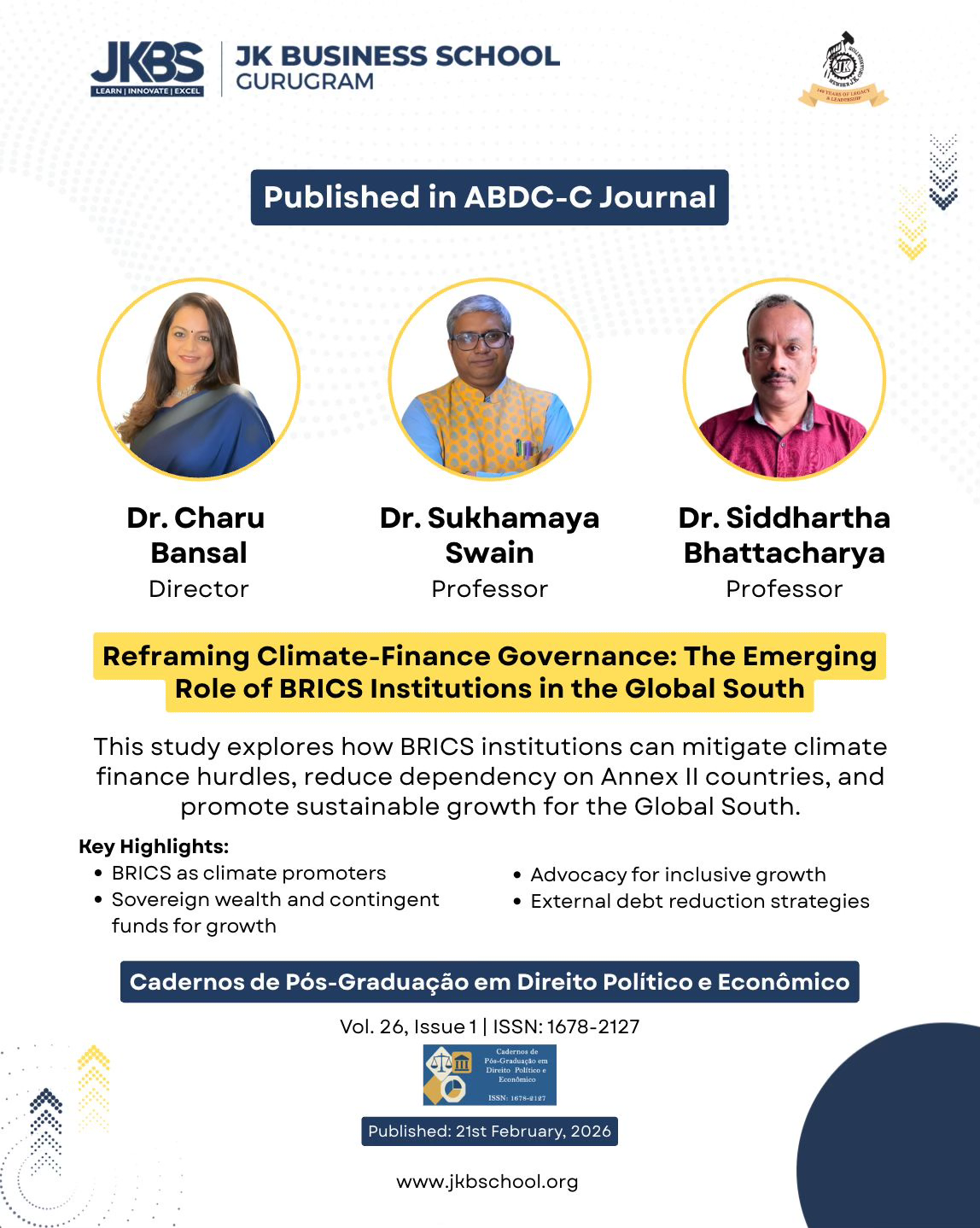
Dr. Charu Bansal, Dr. Sukhamaya Swain, and Dr. Siddhartha Bhattacharya have recently published their research paper titled “Reframing Climate-Finance Governance: The Emerging Role of BRICS Institutions in the Global South” in an ABDC C indexed journal, further strengthening the institution’s contribution to international academic discourse.
Understanding the Research Focus
The study critically examines how climate finance governance is currently structured and the challenges faced by developing nations in accessing adequate funding for climate adaptation and mitigation. Traditionally, climate finance mechanisms have relied heavily on contributions from Annex II countries under global climate agreements. However, this dependency has often resulted in funding gaps, delays, and unequal access.
The research explores how BRICS-led institutions can play a transformative role in reshaping this landscape.
Key Themes Explored in the Study
The paper investigates several important dimensions, including:
- The limitations of existing climate finance frameworks
- The structural dependence on developed nations for funding
- The growing influence of BRICS financial institutions
- Opportunities for strengthening South South cooperation
- The potential for inclusive and sustainable economic growth
By analyzing these aspects, the authors present a comprehensive view of how emerging economies can collectively contribute to a more balanced and resilient climate finance architecture.
The Role of BRICS in Climate Finance
The BRICS grouping has increasingly positioned itself as an alternative platform for global cooperation. Institutions such as the New Development Bank have the capacity to mobilize resources tailored to the specific needs of developing economies.
The research argues that BRICS institutions can:
- Reduce financial dependency on traditional donor countries
- Design funding mechanisms aligned with regional realities
- Support infrastructure and sustainability initiatives
- Promote equitable access to climate finance
This shift has significant implications for countries in the Global South seeking more autonomy and representation in global financial governance.
Academic Contribution and Global Relevance
The paper has been published in Cadernos de Pós-Graduação em Direito Político e Econômico, Volume 26, Issue 1, ISSN 1678 2127, on 21st February 2026. Being featured in an ABDC indexed journal highlights the scholarly rigor and policy relevance of the research.
This publication reflects JK Business School’s commitment to advancing research that addresses real world challenges and contributes to global policy conversations. By examining climate finance through the lens of emerging institutional frameworks, the study provides meaningful insights for policymakers, economists, and sustainability professionals.
Continuing the Research Journey
At JK Business School, research is deeply connected to global impact. Faculty members actively engage with issues that shape economies, governance structures, and sustainable development pathways.
The full research article can be accessed here: Click Here
Through work like this, JK Business School continues to strengthen its position as a center for research excellence, global engagement, and policy relevance.