The financial world has undergone a remarkable transformation over the past decade. From mobile banking and digital payments to artificial intelligence-powered financial services, technology has fundamentally changed how individuals and businesses interact with money.
India has emerged as an important participant in this transformation, supported by expanding digital infrastructure, growing financial technology adoption and innovations in payment systems.
However, as financial services become increasingly digital, a new question is beginning to emerge: What comes after Fintech?
The answer may lie in an emerging concept known as the Finternet, a vision of interconnected financial systems designed to make financial transactions more integrated, accessible and efficient.
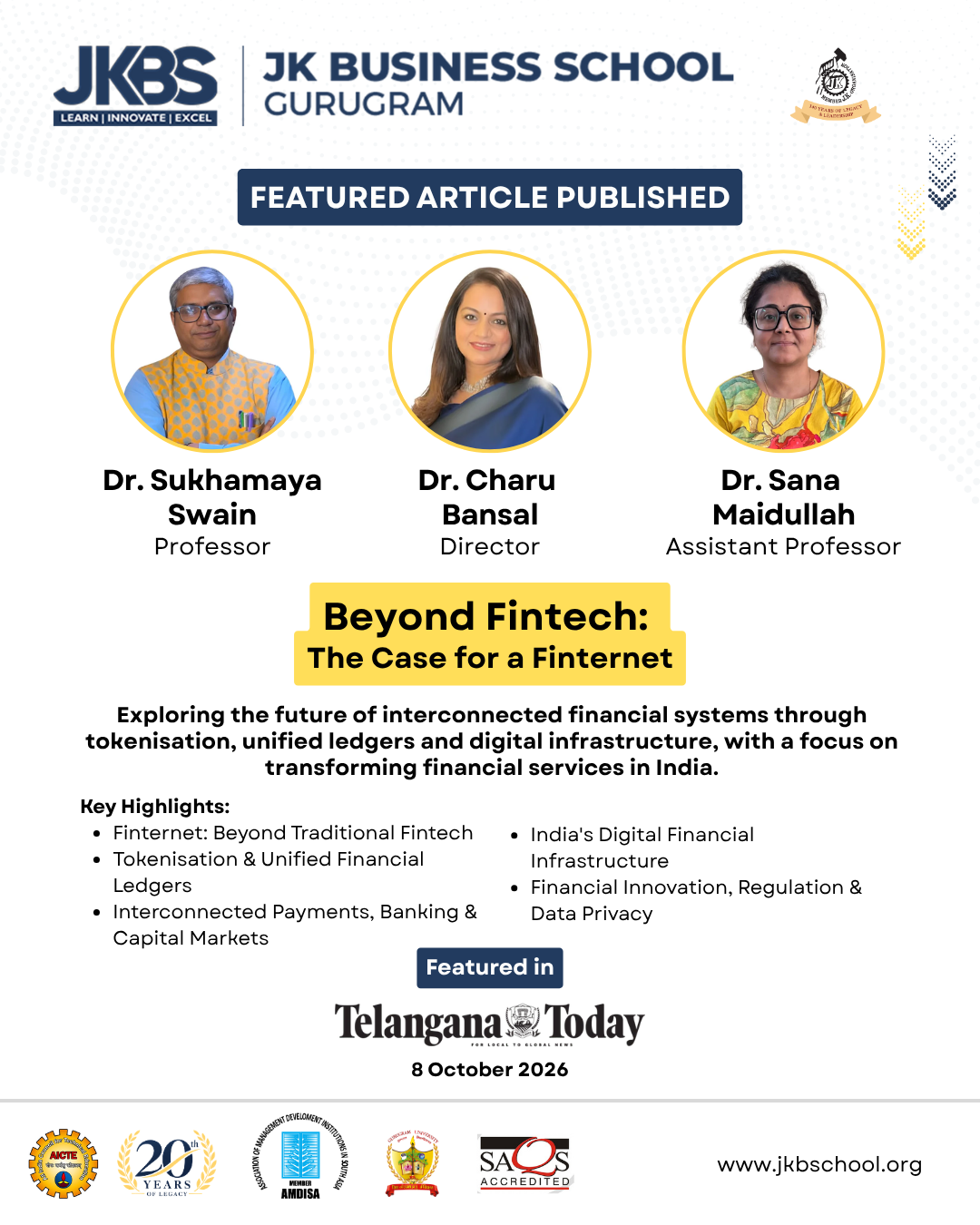
Exploring this development, Dr. Sukhamaya Swain, Dr. Charu Bansal and Dr. Sana Maidullah from JK Business School, Gurugram (JKBS) have co-authored an article titled Beyond Fintech: The Case for a Finternet, published in Telangana Today on 8 October 2026.
The article examines how interconnected financial infrastructure, tokenisation, unified ledgers and technological innovation could reshape the future of financial services in India.
It also brings attention to the opportunities and challenges surrounding digital finance, including regulation, privacy, interoperability and the development of reliable financial ecosystems.
Understanding the Evolution from Fintech to Finternet
Financial technology, commonly known as Fintech, refers to the application of technology to improve or transform financial products and services.
Fintech innovations have changed several aspects of the financial ecosystem, including digital payments, lending, investment management, insurance and banking.
Consumers can now transfer money, make investments, apply for financial products and access banking services through digital platforms.
Businesses have benefited from faster payment processing, improved financial management tools and greater access to digital financial services.
Yet many of these innovations continue to operate through separate platforms, institutions and technological systems.
A customer may use one application for payments, another for investments and a different platform for insurance or lending.
Although each platform may function efficiently, the broader financial ecosystem can remain fragmented.
The concept of the Finternet seeks to address this challenge by envisioning a more connected financial environment.
Instead of focusing exclusively on individual financial applications, the Finternet emphasises the underlying infrastructure that could allow financial systems, assets and services to interact more effectively.
What Is Finternet?
The term Finternet combines the ideas of finance and the internet.
It describes a vision of a financial ecosystem in which different financial networks, institutions and digital assets can operate through interconnected infrastructure.
Just as the internet allows information to move across networks using common technical standards, the Finternet concept seeks to enable financial transactions and services to operate across compatible systems.
The objective is not necessarily to replace banks, financial institutions or existing payment applications.
Instead, it is to explore how these systems could become more interoperable and efficient.
A Finternet-based ecosystem could potentially support the transfer and exchange of different financial assets through shared technological standards and connected platforms.
This may include digital currencies, tokenised deposits, securities and other financial instruments.
The broader vision is to reduce fragmentation and make financial services easier to access across institutions and platforms.
Why the Financial World Is Looking Beyond Fintech
Fintech has delivered significant improvements in convenience, speed and accessibility.
However, the increasing number of financial platforms has also introduced new complexities.
Different financial institutions may maintain separate databases, transaction processing systems, compliance procedures and settlement arrangements.
When transactions involve multiple institutions or different asset classes, coordination can become complicated.
For example, transferring money within a domestic payment system may be relatively straightforward, while completing a cross-border transaction can involve several intermediaries and additional processing requirements.
Similarly, buying and settling financial assets may involve different institutions responsible for trading, clearing, custody and settlement.
These processes serve important financial and regulatory purposes, but they can also create operational complexity.
The Finternet vision explores whether modern digital infrastructure can simplify coordination while preserving necessary safeguards.
Its potential value lies in creating a more connected foundation for financial services rather than merely introducing another financial application.
Tokenisation: A Building Block of the Finternet
One of the important technologies associated with the Finternet concept is tokenisation.
Tokenisation refers to the digital representation of an asset or a claim on an asset through a token recorded on a digital system.
Depending on the design and legal framework, tokenised assets may represent financial instruments, deposits, securities or other forms of value.
For example, a financial asset that traditionally requires several separate recordkeeping and settlement processes could potentially be represented and transferred through a digital ledger.
This could create opportunities for improved transparency, transaction efficiency and automated processing.
How Tokenisation Could Transform Financial Services
Tokenisation may support several developments in the financial sector:
- Greater transaction efficiency: Digital asset records could simplify certain transfer and settlement processes.
- Improved traceability: Authorised participants may be able to verify relevant transaction information more efficiently.
- Programmable financial transactions: Certain conditions could be incorporated into automated transaction processes.
- New financial products: Tokenised structures may support innovation in how assets are issued, held and transferred.
- Potentially broader accessibility: Some tokenisation models could enable new forms of asset participation, subject to regulatory and commercial requirements.
However, tokenisation also raises questions concerning legal ownership, operational resilience, cybersecurity and investor protection.
Its benefits depend on how the underlying systems are designed, governed and regulated.
Unified Ledgers and the Future of Financial Infrastructure
Another important concept associated with the Finternet is the unified ledger.
A unified ledger is a proposed financial infrastructure model that could bring different forms of tokenised money and assets onto a common programmable platform.
Traditional financial transactions often require information and value to move between multiple systems.
Each institution may maintain its own records and verification processes.
A unified ledger could potentially allow certain financial activities to be coordinated within a shared environment.
For instance, transactions involving money and financial assets could be designed so that the exchange of both components occurs together, reducing certain settlement risks.
This is particularly relevant for transactions in which the transfer of an asset must be matched with the transfer of payment.
Unified ledger models may help simplify these processes, although practical implementation requires careful consideration of governance, technology and regulation.
The objective is to create financial infrastructure that supports interoperability without compromising trust or institutional accountability.
India’s Digital Infrastructure and the Finternet Opportunity
India offers an interesting environment for exploring the Finternet because of its expanding digital public infrastructure.
The country’s digital ecosystem already includes technologies that support identity verification, electronic documentation, digital payments and consent-based information sharing.
The Unified Payments Interface (UPI) has demonstrated how interoperable systems can transform everyday financial transactions.
However, the Finternet concept extends beyond payments.
The article by JKBS faculty examines how existing digital capabilities could be connected to create a broader financial infrastructure supporting different financial assets and services.
Potential Applications of Finternet in India
Several areas could benefit from greater integration of financial systems.
1. Agriculture and Crop Insurance
Farmers often interact with banks, insurance providers and government agencies through separate administrative processes.
A more connected financial system could potentially link verified information concerning crop conditions, insurance coverage, identity and banking details.
This could simplify certain insurance claim processes and support more timely settlement, provided that data accuracy and regulatory safeguards are maintained.
2. MSME Financing
Micro, Small and Medium Enterprises frequently face challenges related to access to working capital.
A digitally verifiable invoice connected with relevant financial information could potentially help lenders assess financing requirements more efficiently.
Greater interoperability may reduce some of the delays between invoice generation and access to finance.
3. Government Benefits and Financial Transfers
Government programmes involve different categories of payments, including scholarships, subsidies and direct benefit transfers.
Programmable financial infrastructure could potentially improve the coordination of eligible payments, subject to appropriate verification and safeguards.
4. Investment and Capital Markets
Financial instruments such as bonds, securities and other investment assets could potentially benefit from tokenisation and more integrated transaction systems.
These developments may create opportunities for improved transaction processing and new investment structures.
The extent of these benefits would depend on regulation, market adoption and the design of the underlying infrastructure.
Global Developments: Project Agorá and Project mBridge
The Finternet concept is also connected to international experimentation in financial infrastructure.
The article discusses Project Agorá, an initiative involving central banks and financial institutions exploring the use of tokenised commercial bank deposits and central bank money for cross-border payments.
It also refers to Project mBridge, a multi-central-bank digital currency initiative examining the potential of shared infrastructure for international transactions.
These initiatives illustrate how financial institutions and policymakers are exploring alternatives to fragmented transaction and settlement processes.
They should be understood as experiments and developing models rather than evidence that a complete Finternet system is already operational.
The larger objective is to improve coordination, efficiency and reliability across financial networks.
Challenges in Building a Finternet Ecosystem
Although the Finternet offers significant possibilities, its implementation would involve complex challenges.
Regulatory Coordination
Financial institutions operate under different regulatory requirements across jurisdictions.
A connected financial system would need appropriate rules concerning ownership, settlement, compliance, dispute resolution and institutional responsibility.
Data Privacy and Cybersecurity
Greater connectivity could create new opportunities for financial innovation, but it may also introduce risks related to sensitive financial information.
Systems would need safeguards concerning data access, user consent, security and accountability.
Interoperability
For the Finternet to function effectively, different financial platforms would need compatible technical and operational standards.
Achieving this coordination across institutions, asset classes and countries would require substantial collaboration.
Trust and Institutional Accountability
Financial systems depend on trust.
Users and institutions must have confidence that transactions are secure, legally recognised and accurately recorded.
Clear governance arrangements would therefore be as important as technological capabilities.
Economic Feasibility
Building and maintaining sophisticated financial infrastructure can be expensive.
Institutions would need to evaluate development costs, operational responsibilities and the financial benefits of participation.
A successful model would need to provide meaningful value without creating unnecessary complexity or excessive costs for users.
These considerations reinforce one of the central arguments of the featured article: the future of financial infrastructure depends on governance, economic design and technology working together.
Why Finternet Matters for Management Education
The transition from Fintech towards more interconnected financial infrastructure also has implications for management education.
Future business professionals will need to understand how digital innovation influences financial services, organizational strategy and regulatory compliance.
For students pursuing management education, developments such as tokenisation, unified ledgers and programmable financial transactions create opportunities to explore emerging business models.
They also highlight the growing importance of interdisciplinary knowledge.
Finance professionals increasingly benefit from an understanding of technology. Technology professionals need awareness of financial regulation and business processes. Business leaders must evaluate innovation through commercial, ethical and operational perspectives.
This intersection is particularly relevant for students interested in careers involving finance, business analytics, digital transformation and financial services.
Understanding the Finternet concept can help students appreciate how future financial systems may evolve beyond individual applications towards connected digital ecosystems.
Faculty Thought Leadership at JK Business School, Gurugram
The publication of Beyond Fintech: The Case for a Finternet reflects the engagement of JK Business School, Gurugram faculty with emerging developments in financial innovation and digital transformation.
The article is co-authored by:
- Dr. Sukhamaya Swain, Professor of Finance
- Dr. Charu Bansal, Director
- Dr. Sana Maidullah, Assistant Professor of Marketing
Published in Telangana Today on 8 October 2026, the article contributes to the wider discussion about how financial systems can become more interconnected while addressing questions of regulation, privacy, institutional trust and economic feasibility.
At JK Business School, Gurugram, faculty engagement with contemporary business and economic developments contributes to an academic environment where emerging ideas can be examined through research, discussion and critical analysis.
Such perspectives are relevant to management students preparing to work in industries increasingly influenced by technological change.
The Future of Finance: From Individual Applications to Connected Ecosystems
The financial industry has made substantial progress through digital innovation.
Fintech applications have improved access to payments, banking, investments and other services. Yet the next stage of financial transformation may depend on improving the infrastructure connecting those services.
The Finternet concept presents a vision in which financial assets, institutions and networks interact through compatible digital systems.
Tokenisation could change how assets are represented. Unified ledgers could support new transaction structures. Interoperable infrastructure could simplify coordination across financial services.
However, these possibilities will require careful attention to regulation, privacy, security and economic sustainability.
The success of future financial systems will depend not only on technological capability but also on their ability to operate reliably and serve the needs of individuals, businesses and institutions.
Frequently Asked Questions About Finternet
1. What is Finternet?
Finternet is a proposed vision of interconnected financial infrastructure that could allow different financial systems, institutions and digital assets to interact more efficiently through compatible technological frameworks.
2. How is Finternet different from Fintech?
Fintech generally focuses on improving or digitising financial products and services. Finternet focuses on the broader infrastructure connecting financial systems, potentially enabling greater interoperability across institutions and asset classes.
3. What role does tokenisation play in Finternet?
Tokenisation allows certain financial assets or claims to be represented digitally. It could support more efficient processing, transfer and settlement of financial instruments within appropriately designed systems.
4. What is a unified ledger?
A unified ledger is a proposed platform that can bring different forms of tokenised money and financial assets together, allowing certain transactions to be coordinated within a shared infrastructure.
5. Can Finternet benefit India’s MSMEs?
Potentially, yes. More connected financial systems could improve the verification and processing of financial information, including invoices, and support more efficient access to certain financing services.
6. What are the major challenges facing Finternet?
Important challenges include regulatory coordination, cybersecurity, privacy, interoperability, legal recognition of transactions, institutional accountability and implementation costs.
7. Who authored the article Beyond Fintech: The Case for a Finternet?
The article was co-authored by Dr. Sukhamaya Swain, Dr. Charu Bansal and Dr. Sana Maidullah from JK Business School, Gurugram.
8. Where was the article published?
The article was published in Telangana Today on 8 October 2026.
Conclusion: A New Direction for Digital Financial Innovation
The future of financial services may not be defined solely by the development of new applications or digital banking products.
It may increasingly depend on how effectively different financial institutions, assets and technological platforms can interact.
The Finternet concept offers an opportunity to reconsider the foundations of financial infrastructure and explore how greater connectivity could improve financial services.
For India, existing digital capabilities provide a starting point for examining these possibilities.
At the same time, the transition towards interconnected financial architecture will require thoughtful regulatory frameworks, strong governance and a commitment to user trust.
Through their article Beyond Fintech: The Case for a Finternet, Dr. Sukhamaya Swain, Dr. Charu Bansal and Dr. Sana Maidullah of JK Business School, Gurugram contribute to this important discussion on the future of finance.
Their perspectives highlight why technological progress must be considered alongside economic, regulatory and institutional realities.
As digital finance continues to evolve, understanding concepts such as the Finternet will become increasingly relevant for policymakers, financial institutions, researchers and future business leaders.
Read the original featured article: Beyond Fintech: The Case for a Finternet, Telangana Today, 8 October 2026