The global space sector is moving into an exciting phase where scientific exploration increasingly intersects with technology, entrepreneurship, investment and new business models. What was once largely the domain of government agencies is developing into a broader economic ecosystem involving private enterprises, researchers, technology companies and emerging ventures.
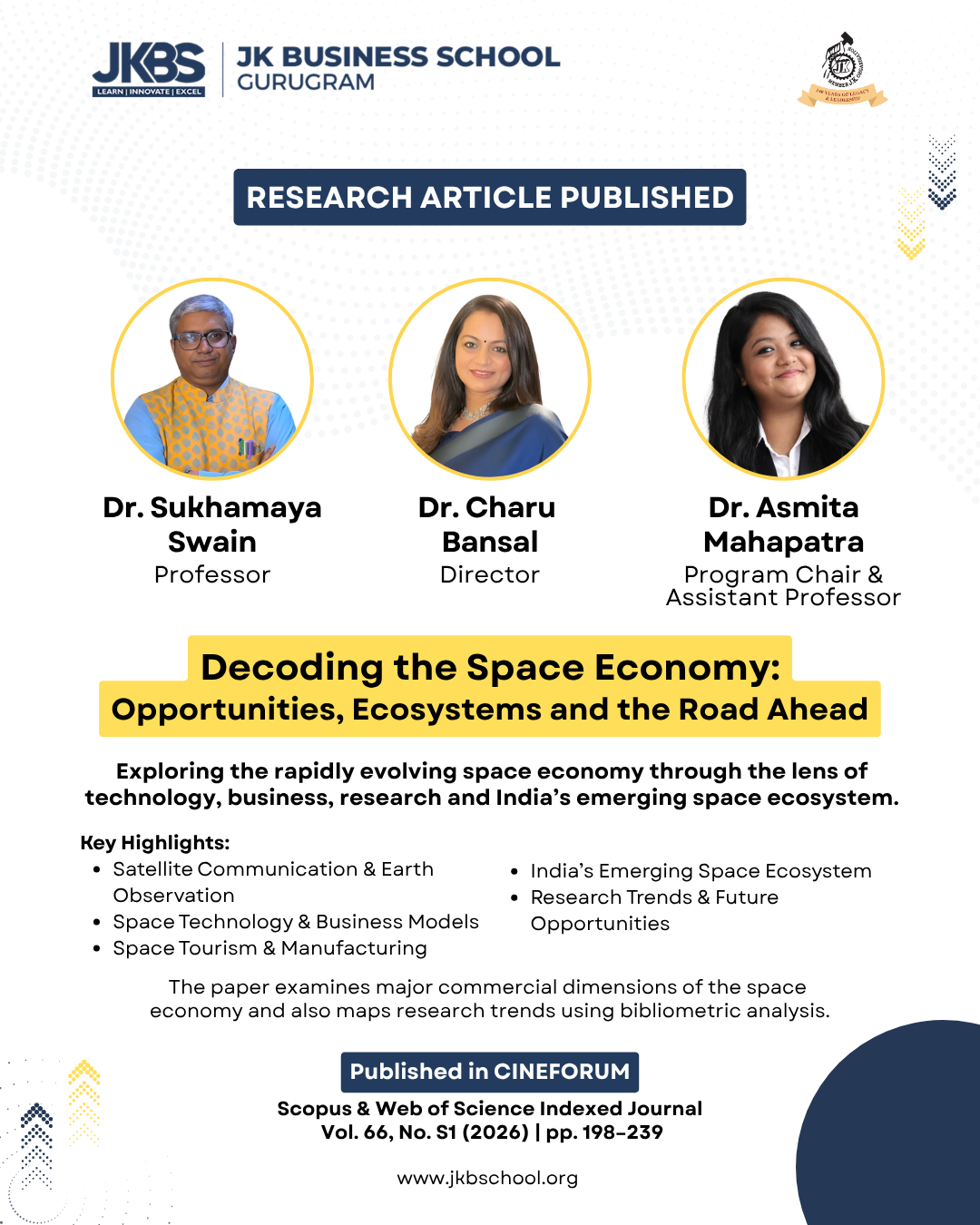
Against this evolving backdrop, faculty members from JK Business School, Gurugram have contributed to the academic discourse through a research article titled “Decoding the Space Economy: Opportunities, Ecosystems and the Road Ahead.”
The research has been co-authored by Dr. Sukhamaya Swain, Professor; Dr. Charu Bansal, Director; and Dr. Asmita Mahapatra, Program Chair & Assistant Professor at JK Business School, Gurugram.
Published in CINEFORUM, a Scopus and Web of Science indexed journal, the article appears in Volume 66, No. S1 (2026), pages 198-239.
The research examines the rapidly evolving space economy through multiple dimensions, including technology, business models, satellite communication, Earth observation, manufacturing, space tourism and India’s emerging space ecosystem. It also maps research trends through bibliometric analysis, providing an academic perspective on a sector with growing economic and strategic significance.
Understanding the Emerging Space Economy
The term space economy extends far beyond rockets and space missions. It encompasses a growing network of commercial activities, technologies, services and industries that either operate in space or rely on space-based infrastructure.
Satellite communication, navigation services, Earth observation, manufacturing, data services and emerging commercial applications are all becoming part of this expanding ecosystem.
As technology develops and participation in the sector broadens, the economic possibilities associated with space are also changing.
This makes the space economy an important subject not only for scientists and engineers, but also for management researchers, entrepreneurs, policymakers, investors and business leaders.
The research by the JKBS faculty approaches the subject through this broader lens, examining the commercial dimensions of the space economy while also considering its technological and research foundations.
Satellite Communication and Earth Observation
One of the major areas examined in the research is satellite communication and Earth observation.
Satellites have become deeply connected with modern economic activity. Communication networks, navigation, weather information and Earth observation services increasingly influence the way businesses, governments and communities operate.
Earth observation, in particular, creates opportunities to gather and interpret information about the planet using satellite-based technologies. The resulting data can support decision making and create new possibilities for organizations working with geospatial information and technology-enabled services.
Satellite communication also remains an important component of the wider space economy, connecting technological infrastructure with commercial applications.
By including these areas in the study, the research highlights how the space economy connects advanced technology with services that have relevance on Earth.
Space Technology and Emerging Business Models
Another significant dimension explored in the article is the relationship between space technology and business models.
Technological innovation can create commercial opportunities only when it is supported by viable models for delivering value. As participation in the space sector expands, businesses must consider how emerging technologies can be transformed into scalable products and services.
This brings management thinking directly into the conversation.
Questions around investment, market development, commercialization, partnerships and long-term sustainability become increasingly important as the sector evolves.
For management researchers, the space economy therefore provides a fascinating area of study because it sits at the intersection of innovation, technology, strategy and entrepreneurship.
The research helps broaden the discussion from what space technology can accomplish to how a sustainable ecosystem around such technologies can develop.
Space Manufacturing and New Commercial Possibilities
Space manufacturing is another area highlighted by the study.
Manufacturing forms an important part of any developing technological ecosystem. Within the space economy, it creates opportunities associated with the development of components, systems and supporting technologies required for different space-related applications.
As commercial participation grows, the relationships between research institutions, technology developers, manufacturers and businesses become increasingly important.
Understanding these connections can help researchers and industry stakeholders identify how different participants contribute to the wider ecosystem.
The paper’s focus on manufacturing also demonstrates the multidisciplinary nature of the space economy. It is not a standalone sector operating in isolation. It can create connections with engineering, technology, supply chains, research, investment and management.
Space Tourism and the Expansion of Commercial Space Activity
Among the emerging areas discussed in the research is space tourism.
Although still developing, space tourism represents an interesting example of how commercial opportunities can emerge from advances in space technology.
Its inclusion within the study demonstrates how the definition of the space economy continues to expand.
Commercial space activity is creating conversations around new services, customer experiences and business possibilities that were once considered futuristic.
For management scholars, these developments provide an opportunity to examine how entirely new markets emerge, how businesses respond to technological disruption and how consumer-facing models can develop around highly advanced technologies.
India’s Emerging Space Ecosystem
A particularly relevant dimension of the research is its focus on India’s emerging space ecosystem.
India’s space landscape provides an important context for studying how technology, research, commercial opportunities and ecosystem development can come together.
As new possibilities emerge, understanding the broader structure of the ecosystem becomes essential.
The research places India’s developments within the wider conversation around the space economy, helping examine opportunities through an academic and business-oriented perspective.
This is particularly valuable for management education because emerging sectors require professionals who can understand technology while also thinking about strategy, finance, markets, operations and organizational growth.
The space economy offers a strong example of why contemporary management education must remain connected with industries and technologies that are still taking shape.
Mapping Research Trends Through Bibliometric Analysis
An important aspect of the published work is its use of bibliometric analysis to map research trends.
As an academic field develops, understanding the existing body of research can help identify patterns, areas of concentration and emerging directions.
Bibliometric analysis provides a structured way to examine scholarly literature and understand how research around a particular subject is evolving.
In the context of the space economy, such analysis becomes particularly relevant because the field draws upon multiple disciplines.
Technology, economics, business, policy and innovation can all contribute to the conversation.
By mapping research trends, the article contributes to a clearer understanding of how academic interest in the space economy is developing and where future research opportunities may emerge.
Why Space Economy Research Matters for Management Education
At first glance, space research may appear distant from conventional management education. In reality, the growing commercialization of the sector makes management thinking increasingly relevant.
Emerging space enterprises require professionals who can understand:
- Business strategy and market development
- Finance and investment decisions
- Technology commercialization
- Supply chains and operations
- Innovation and entrepreneurship
- Research and ecosystem development
This makes the space economy an important example of how management disciplines interact with emerging technologies.
For students, exposure to research on such subjects can encourage them to think beyond traditional industry boundaries and understand how new sectors develop.
It also reinforces the importance of interdisciplinary learning. Future managers may not need to design satellites or launch vehicles, but they may increasingly work in organizations whose strategies depend on advanced technology and data-driven ecosystems.
Research That Connects with Emerging Business Realities
Academic research becomes particularly meaningful when it engages with questions that have relevance beyond the classroom.
The publication of “Decoding the Space Economy: Opportunities, Ecosystems and the Road Ahead” reflects this approach at JK Business School, Gurugram.
By studying a rapidly evolving sector through the perspectives of technology, business, commercial opportunities and academic research, the authors contribute to a conversation that is likely to become increasingly significant in the years ahead.
The article also reflects how management research can engage with emerging fields instead of remaining limited to established business sectors.
Strengthening the Research Culture at JK Business School, Gurugram
Research and knowledge creation form an important part of the academic environment at JK Business School, Gurugram.
Faculty publications contribute not only to scholarly literature but also to classroom discussions and the broader intellectual environment of the institution.
Research into emerging subjects such as the space economy allows faculty members to engage with developments that can shape future industries and business opportunities.
For students, being part of a research-oriented academic environment can encourage curiosity, critical thinking and a stronger understanding of how knowledge is developed.
The publication by Dr. Sukhamaya Swain, Dr. Charu Bansal and Dr. Asmita Mahapatra represents another contribution to this growing research culture.
Looking at the Road Ahead
The space economy represents an evolving intersection of technology, research and commercial opportunity.
From satellite communication and Earth observation to manufacturing, new business models and space tourism, the sector is opening multiple areas for academic and business exploration.
At the same time, India’s emerging space ecosystem creates an important context for understanding how these opportunities may develop closer to home.
The research article “Decoding the Space Economy: Opportunities, Ecosystems and the Road Ahead” brings these dimensions together while also mapping research trends through bibliometric analysis.
Its publication in CINEFORUM, a Scopus and Web of Science indexed journal, adds to the continuing academic contributions from faculty members at JK Business School, Gurugram.
As new technologies reshape industries and create entirely new markets, research that examines what lies ahead becomes increasingly valuable. This publication contributes to that understanding by looking beyond the present and exploring the possibilities shaping the future of the space economy.