Artificial Intelligence is changing the way people work, communicate, learn and make decisions. Yet some of its most profound implications are emerging far beyond business applications and productivity tools. AI is beginning to enter deeply personal areas of human life, including how people remember loved ones, preserve memories and respond to loss.
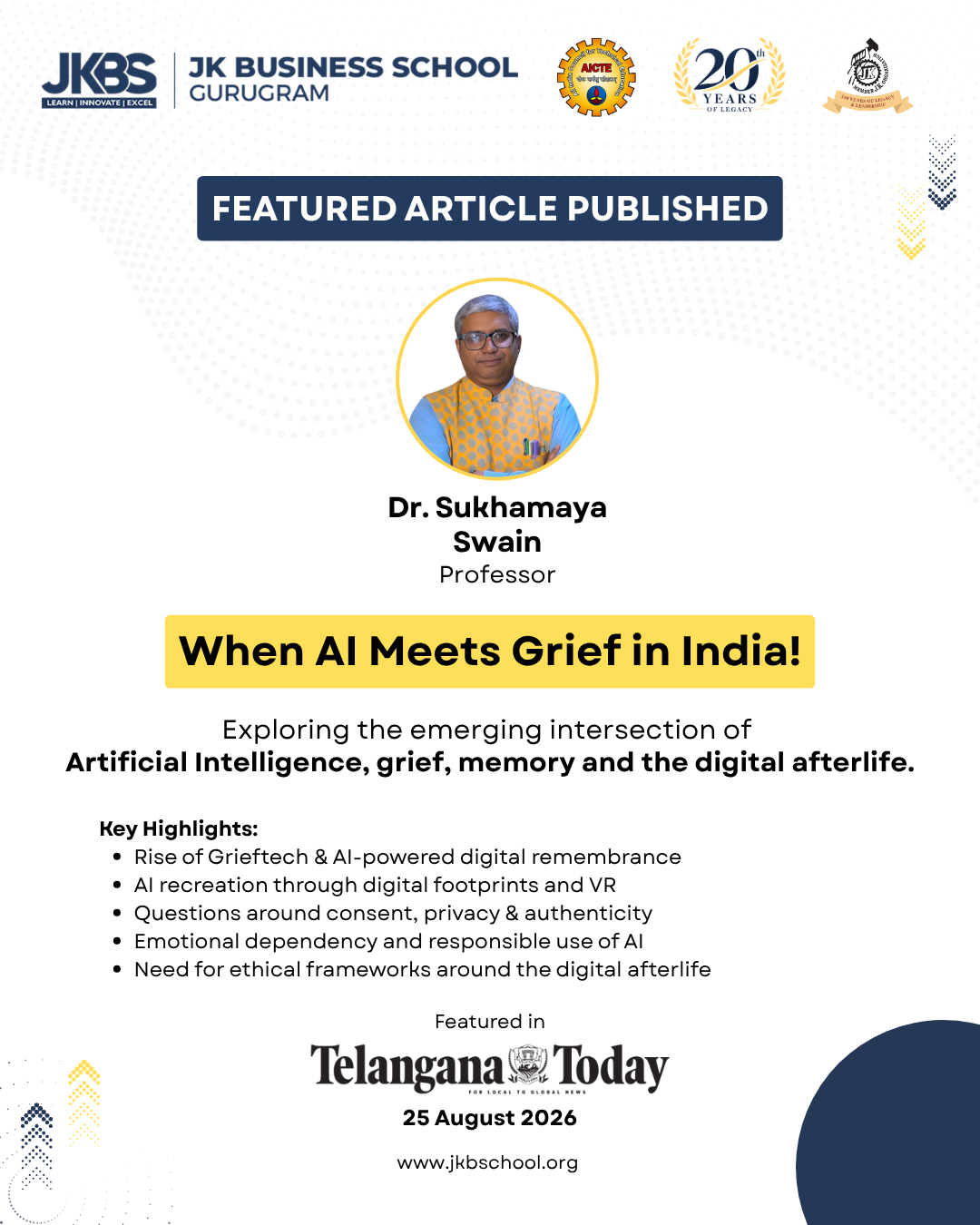
This emerging intersection of Artificial Intelligence, grief, memory and the digital afterlife is explored by Dr. Sukhamaya Swain, Professor at JK Business School, Gurugram (JKBS), in his featured article titled When AI Meets Grief in India!, published in Telangana Today on 25 August 2026.
The article brings attention to the growing field of Grieftech, where AI-powered technologies, digital footprints and virtual experiences are creating new possibilities for remembrance. At the same time, these technologies raise complex questions about privacy, consent, authenticity, emotional dependency and responsible innovation.
As AI becomes increasingly capable of recreating aspects of human communication and identity, the conversation is no longer limited to what technology can do. An equally important question is what technology should do.
What Is Grieftech?
Grieftech refers broadly to technologies designed to support remembrance, mourning and interaction with the digital presence of someone who has passed away.
For decades, photographs, letters, recordings and personal belongings have helped families preserve memories. Digital life has dramatically expanded what can remain behind after a person is gone.
Today, people leave enormous digital footprints through photographs, videos, voice recordings, emails, messages, social media activity and other forms of online communication. Advances in AI have made it possible to process these digital traces in increasingly sophisticated ways.
This can potentially allow technology to recreate elements such as a person’s voice, conversational patterns or digital appearance. Combined with immersive technologies such as virtual reality, the concept of remembrance can move from viewing static memories towards more interactive digital experiences.
This shift creates fascinating possibilities, but it also introduces questions that society has only begun to address.
From Digital Footprints to Digital Presence
Almost everyone who regularly uses digital technology creates a personal archive, intentionally or otherwise.
Social media profiles contain photographs, opinions and conversations. Smartphones store thousands of images and videos. Messaging applications contain years of personal exchanges. Cloud platforms preserve documents, recordings and other information.
Individually, these pieces of information may appear ordinary. Together, however, they can create a detailed digital representation of an individual.
Artificial Intelligence can identify patterns within such information. Generative AI systems can produce text, images, audio and other content based on existing data.
When these capabilities are applied to memories of deceased individuals, a new category of ethical and emotional questions emerges.
Does a digital recreation represent the person or merely an algorithmic interpretation of available data?
Who should have the authority to create it?
Who owns the digital information required to build it?
Should consent be obtained before a person’s digital identity can be recreated after death?
These questions demonstrate why Grieftech is not simply another application of Artificial Intelligence.
The Question of Consent
One of the most significant issues surrounding AI-powered digital remembrance is consent.
A person may have willingly shared photographs, videos or messages during their lifetime. That does not automatically mean they agreed for this information to be used to create an interactive digital version of themselves after death.
This distinction becomes increasingly important as AI systems become more capable.
Traditional digital memorials usually preserve information that already exists. Generative AI can potentially create new responses, conversations or representations based on the available material.
That introduces a different level of complexity.
The resulting digital personality may say things that the original person never actually said. It may generate responses based on patterns inferred by an algorithm rather than genuine memories or intentions.
Responsible approaches to Grieftech therefore need to consider how consent should be obtained, documented and respected.
Privacy Does Not End With Data Collection
Privacy is another important dimension of the discussion.
Digital memories rarely involve only one individual. A person’s messages may include conversations with family members, friends and colleagues. Photographs may feature other people. Emails may contain confidential or personal information.
Using such data to create AI-powered experiences can therefore affect the privacy of multiple individuals.
This raises questions around data ownership, storage and access.
Who controls the digital footprint after someone’s death? What information can legitimately be used? How long should that information be stored? Can relatives request its deletion? What happens if different family members disagree about how the data should be used?
As AI applications become more sophisticated, privacy frameworks may need to consider these scenarios more carefully.
Authenticity in an AI-Generated Memory
AI can imitate patterns, but imitation and authenticity are not the same thing.
An AI system trained on someone’s digital footprint may reproduce certain phrases, expressions or characteristics. Yet the output remains generated by technology.
This distinction matters greatly when emotional attachment is involved.
People interacting with AI-generated representations need clarity about what they are experiencing. Without appropriate transparency, the boundary between authentic memory and algorithmically generated content could become difficult to understand.
The issue becomes even more significant as synthetic voices, realistic avatars and virtual reality experiences become more convincing.
Responsible design therefore requires more than technical accuracy. It also requires clear communication about what is real, what has been recreated and what has been generated.
Emotional Dependency and Human Well-Being
Perhaps the most sensitive aspect of Grieftech concerns emotional dependency.
Grieving is deeply personal. Different individuals process loss in different ways and over different periods of time.
Technology may offer comfort by preserving memories or providing spaces for remembrance. At the same time, interactive simulations of deceased individuals could influence how people experience and process grief.
If an AI recreation is available at any moment, users may develop patterns of interaction that are very different from traditional forms of remembrance.
This raises an important challenge for technology developers and society: how can innovation support human well-being without encouraging unhealthy emotional dependence?
There may not be one universal answer.
However, responsible development requires acknowledging that users engaging with Grieftech may be emotionally vulnerable. Design decisions therefore carry consequences beyond ordinary user experience.
India and the Emerging Digital Afterlife
The conversation becomes particularly relevant in India because of the country’s rapidly expanding digital ecosystem.
Digital payments, smartphones, social platforms, cloud services and AI applications are becoming increasingly integrated into everyday life. As more personal experiences are recorded digitally, the amount of information people leave behind will continue to grow.
India also has diverse cultural, familial and spiritual traditions surrounding death, remembrance and mourning.
Technology entering this space therefore cannot be understood purely from a technical perspective. Cultural context matters.
How families view digital remembrance, what forms of technological interaction they consider appropriate and how communities respond to AI-generated representations may vary significantly.
The emergence of Grieftech in India therefore creates a need for dialogue involving technologists, policymakers, researchers, ethicists and society.
Why Responsible AI Frameworks Matter
The discussion around Grieftech highlights a larger principle in Artificial Intelligence: innovation needs to be accompanied by responsibility.
Technology often advances faster than social norms and regulatory frameworks. By the time a new application becomes widely accessible, difficult questions around its use may already have emerged.
Responsible AI frameworks can help establish principles concerning:
- Informed consent for the use of personal digital data
- Privacy and protection of digital footprints
- Transparency around AI-generated content
- Clear ownership and access rights
- Safeguards against misuse or manipulation
- Consideration of emotional and psychological implications
- Accountability for organizations developing such technologies
These issues are not limited to Grieftech. They are relevant to the wider debate about how Artificial Intelligence should operate in areas involving identity, emotion and personal information.
AI Innovation Is Also a Management Question
The rise of technologies such as Grieftech also offers an important perspective for management education.
Future business leaders will operate in an environment where technological capability and ethical responsibility increasingly intersect.
A company may be technically capable of creating a product, but managers must still ask whether it should be developed, how it should be governed and what safeguards should accompany it.
This requires professionals to think beyond immediate commercial opportunities.
Issues involving AI governance, privacy, ethics, regulation, consumer trust and responsible innovation are becoming important components of contemporary business decision-making.
For management students, understanding AI therefore means more than learning how the technology can improve productivity or automate processes. It also means developing the ability to evaluate its social consequences.
Faculty Thought Leadership at JK Business School, Gurugram
Dr. Sukhamaya Swain’s featured article reflects the importance of engaging with emerging issues that sit at the intersection of technology, society, ethics and management.
At JK Business School, Gurugram, such faculty contributions help extend academic conversations beyond conventional classroom subjects and connect them with developments shaping the wider world.
Artificial Intelligence is already transforming industries, but its influence on society will depend significantly on the choices made by businesses, policymakers, technology developers and users.
Conversations around Grieftech demonstrate why those choices deserve careful consideration.
Looking Beyond What AI Can Do
The evolution of Artificial Intelligence continues to challenge existing assumptions about technology and human experience.
Grieftech represents one of the clearest examples.
Digital footprints can preserve memories. AI can analyse those footprints. Generative technologies can recreate elements of communication, voice and visual identity. Virtual environments can make those representations increasingly immersive.
But technological capability alone cannot answer questions of consent, authenticity, privacy or emotional responsibility.
These questions require human judgement.
As AI enters increasingly personal areas of life, society will need frameworks that encourage innovation while respecting dignity, autonomy and emotional well-being.
The featured article When AI Meets Grief in India! by Dr. Sukhamaya Swain contributes to this timely conversation by examining an emerging technological phenomenon through a broader social and ethical lens.
For students, academics, policymakers and business leaders, the subject offers an important reminder: the future of Artificial Intelligence will not be determined only by how advanced algorithms become. It will also be shaped by the principles used to guide them.
At JK Business School, Gurugram, engagement with such emerging conversations reflects a wider commitment to research, thought leadership and management education that connects technological transformation with the realities of society.