
Research and innovation play an important role in advancing management education, addressing business challenges and developing new approaches to understanding market dynamics. Academic institutions that encourage applied research create opportunities for faculty members to contribute beyond traditional classroom teaching and explore ideas with practical relevance.
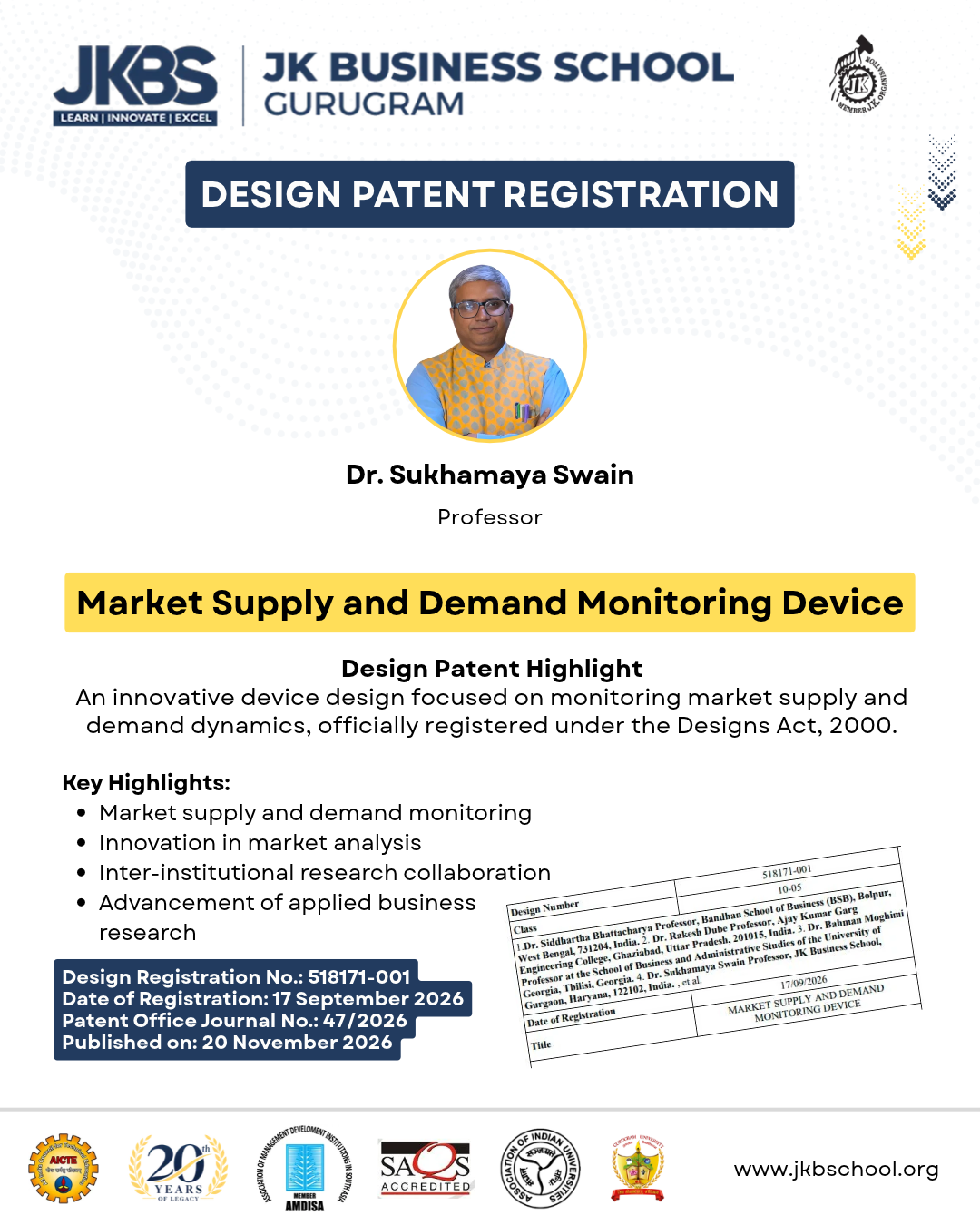
Marking another significant milestone in its research and innovation journey, JK Business School, Gurugram (JKBS) highlights the contribution of Dr. Sukhamaya Swain, Professor at JKBS, towards the development of a registered design titled “Market Supply and Demand Monitoring Device.”
The design has been officially registered with the Patent Office, Government of India, under the Designs Act, 2000. Registered on 17 September 2026, the design was subsequently published in the Patent Office Journal on 20 November 2026.
This achievement highlights the importance of innovation in market analysis, inter-institutional research collaboration and the advancement of applied business research. It also reflects the growing relevance of intellectual property creation within management education.
Design Registration: Key Details of the Achievement
The registration represents a collaborative research achievement focused on the design of a device intended for monitoring market supply and demand dynamics.
| Particulars | Details |
|---|---|
| Design Title | Market Supply and Demand Monitoring Device |
| Faculty Contributor from JKBS | Dr. Sukhamaya Swain |
| Designation | Professor |
| Design Registration Number | 518171-001 |
| Design Classification | 10-05 |
| Date of Registration | 17 September 2026 |
| Date of Publication | 20 November 2026 |
| Patent Office Journal Number | 47/2026 |
| Governing Legislation | Designs Act, 2000 |
| Registration Authority | Patent Office, Government of India |
The registration provides formal recognition of the design under India’s intellectual property framework and marks an important development in the collaborative research initiative.
Understanding the Market Supply and Demand Monitoring Device
Supply and demand are among the most fundamental concepts in economics and business management. They influence pricing decisions, production planning, inventory management, consumer behaviour and overall market performance.
Businesses operate in environments where market conditions can change rapidly. Consumer preferences evolve, production costs fluctuate, competitors introduce new offerings and external economic developments influence purchasing decisions.
Understanding these changes is essential for organisations seeking to make informed business decisions.
The registered design titled Market Supply and Demand Monitoring Device focuses on the concept of monitoring market supply and demand dynamics.
The research initiative brings attention to the intersection of market analysis, innovation and device design. It represents an approach to exploring how business research can extend beyond theoretical frameworks and contribute to the development of tangible concepts.
While the registration recognises the design of the device, its broader research theme highlights the importance of developing innovative approaches to understanding market conditions.
Why Supply and Demand Monitoring Matters in Business
Effective business management requires an understanding of the relationship between product availability and consumer demand.
When demand increases unexpectedly, businesses may face inventory shortages, delayed deliveries and missed sales opportunities. Conversely, when supply exceeds demand, organisations may experience excess inventory, increased storage costs and pressure on profit margins.
Monitoring market dynamics helps businesses understand these challenges and evaluate their operational strategies.
Supporting Strategic Decision-Making
Business leaders need reliable information when making decisions related to production, pricing, expansion and resource allocation.
An understanding of supply and demand trends can help organisations assess market opportunities and respond to changing business conditions.
Improving Inventory Management
Maintaining appropriate inventory levels is an important consideration for retailers, manufacturers and distributors.
Understanding demand patterns can support better inventory planning and help businesses balance product availability with operational costs.
Understanding Consumer Behaviour
Changes in demand often reflect shifts in consumer preferences, purchasing power and market expectations.
Studying these patterns allows businesses to evaluate whether their products and services remain relevant to their target audiences.
Strengthening Supply Chain Planning
Supply chain management involves coordinating procurement, production, transportation and distribution.
Awareness of changing market conditions can help organisations improve planning and prepare for potential disruptions.
These examples illustrate the broader business relevance of the research area associated with the registered design.
Innovation in Market Analysis and Applied Business Research
Traditional business research often focuses on understanding economic behaviour, organisational performance, consumer preferences and market trends through theoretical and analytical methods.
Applied business research takes these concepts further by exploring how knowledge can contribute to addressing practical challenges.
The development of the Market Supply and Demand Monitoring Device design highlights the relationship between academic inquiry and innovation.
It demonstrates how researchers from management and related disciplines can explore ideas that connect economic principles with practical design concepts.
Some important areas where applied business research can contribute include:
- Market intelligence and competitive analysis
- Demand forecasting and business planning
- Inventory and resource optimisation
- Consumer behaviour analysis
- Supply chain and operational efficiency
- Business strategy and decision-making
- Technology-enabled management practices
Research initiatives focused on these areas encourage academics and management professionals to examine business challenges from multiple perspectives.
They also highlight the importance of creativity, analytical thinking and interdisciplinary collaboration in developing innovative concepts.
What Is Design Registration Under the Designs Act, 2000?
Intellectual property rights provide legal protection for different forms of creativity and innovation.
In India, the Designs Act, 2000 governs the registration and protection of industrial designs.
A registered design generally protects the visual features of an article, including its shape, configuration, pattern or ornamentation, subject to the applicable legal requirements.
Although design registrations are sometimes referred to as design patents, they differ from patents that protect technical inventions and functional innovations.
| Design Registration | Invention Patent |
|---|---|
| Protects eligible visual features of an article | Protects eligible technical inventions |
| Governed by the Designs Act, 2000 | Governed by the Patents Act, 1970 |
| Focuses on appearance and design | Focuses on technical invention and functionality |
| Provides protection for a registered design | Provides protection for a patented invention |
The registration of the Market Supply and Demand Monitoring Device under the Designs Act, 2000 represents formal recognition of its registered design.
Such achievements encourage researchers to understand the importance of intellectual property protection and the role it plays in supporting innovation.
The Importance of Inter-Institutional Research Collaboration
One of the significant aspects of this achievement is the collaboration between researchers associated with different academic institutions.
Modern business challenges frequently extend across disciplinary and institutional boundaries. Addressing these challenges may require perspectives from management, economics, engineering, technology and other fields.
Inter-institutional research collaboration creates opportunities for researchers to exchange knowledge, explore different methodologies and develop ideas collectively.
Such collaborations can contribute to:
- Exchange of academic knowledge and research expertise
- Development of interdisciplinary research approaches
- Exploration of innovative business concepts
- Strengthening of professional and academic networks
- Creation of opportunities for future research initiatives
The contribution of Dr. Sukhamaya Swain to this registered design reflects the importance of collaborative academic engagement and the value of bringing together different areas of expertise.
For management institutions, collaborative research also provides opportunities to explore subjects beyond conventional academic boundaries.
Intellectual Property and Its Growing Relevance in Management Education
Intellectual property creation is often associated with engineering, scientific research and technological development. However, it is equally relevant to the broader business and management ecosystem.
Management professionals frequently work with organisations that develop new products, services, brands, processes and business models.
Understanding intellectual property rights can help future managers appreciate how organisations protect creative assets, manage innovation and develop competitive advantages.
For management students, awareness of intellectual property is particularly relevant in areas such as entrepreneurship, product development, marketing, business strategy and innovation management.
Faculty achievements involving design registration introduce students to another dimension of academic research and demonstrate how creative ideas can receive formal legal recognition.
They also encourage students to consider innovation as an integral part of business development rather than viewing it exclusively as a technical activity.
What This Achievement Means for Management Students
Research achievements by faculty members can provide valuable inspiration for students pursuing management education.
The registration of a design focused on market supply and demand monitoring connects with several concepts that students encounter during their academic programmes.
These include managerial economics, marketing management, business analytics, operations management and logistics and supply chain management.
Understanding the relationship between these subjects helps students develop a broader perspective on business challenges.
For example, a marketing professional needs to understand consumer demand, while an operations manager must evaluate production capacity and resource availability. A supply chain professional must consider how changes in demand influence procurement and distribution decisions.
Research-oriented learning encourages students to examine these relationships and explore how innovative approaches could contribute to better business decisions.
It also reinforces the importance of problem-solving, curiosity and evidence-based thinking in professional development.
Strengthening the Research Culture at JK Business School, Gurugram
At JK Business School, Gurugram, academic development extends beyond classroom instruction through faculty research, scholarly publications, industry interactions and collaborative learning initiatives.
Faculty engagement with contemporary business challenges contributes to an academic environment where students can explore emerging ideas and understand their relevance to professional practice.
Research achievements such as the registered design of the Market Supply and Demand Monitoring Device highlight the role of faculty members in advancing academic inquiry and exploring innovative concepts.
They also complement the institution’s emphasis on industry-oriented management education, experiential learning and the development of analytical capabilities.
Drawing upon the 140+ years of legacy of JK Organisation, JK Business School, Gurugram continues to encourage academic excellence, innovation and professional development.
The contribution of Dr. Sukhamaya Swain adds another milestone to the institution’s research and innovation journey.
Frequently Asked Questions
1. What is the title of the design registered by Dr. Sukhamaya Swain and his fellow contributors?
The registered design is titled Market Supply and Demand Monitoring Device. It focuses on the concept of monitoring market supply and demand dynamics.
2. What is the design registration number?
The official design registration number is 518171-001.
3. When was the Market Supply and Demand Monitoring Device registered?
The design was officially registered on 17 September 2026 and published in the Patent Office Journal on 20 November 2026.
4. Under which legislation was the design registered?
The design was registered with the Patent Office, Government of India, under the Designs Act, 2000.
5. Is design registration the same as an invention patent?
No. Design registration generally protects the eligible visual features of an article, while an invention patent protects an eligible technical invention. Both are forms of intellectual property protection governed by different legal frameworks.
6. Why is supply and demand monitoring important for businesses?
Understanding supply and demand dynamics helps businesses evaluate market conditions, plan inventory, develop pricing strategies and make informed operational decisions.
7. How does this achievement contribute to management education?
The achievement highlights the importance of applied business research, intellectual property awareness, interdisciplinary collaboration and innovation in understanding contemporary business challenges.
Conclusion: Celebrating Research, Innovation and Academic Excellence
The registration of the Market Supply and Demand Monitoring Device, with the contribution of Dr. Sukhamaya Swain, Professor at JK Business School, Gurugram, represents a significant milestone in applied business research and collaborative innovation.
Officially registered under the Designs Act, 2000 and published in the Patent Office Journal on 20 November 2026, the achievement highlights the importance of intellectual property creation within the academic community.
It also reinforces the relevance of market analysis, interdisciplinary research and innovative thinking in addressing contemporary business challenges.
JK Business School, Gurugram congratulates Dr. Sukhamaya Swain and his fellow research contributors on this achievement and wishes them continued success in their academic and research endeavours.
Through such achievements, JK Business School, Gurugram continues to strengthen its commitment to research, innovation, academic excellence and industry-oriented management education.


