As economies become increasingly digital, international trade in services is being influenced not only by technology and connectivity but also by differences in regulatory frameworks across countries. Understanding how these differences affect trade has become an important area of research for policymakers, businesses and academics.
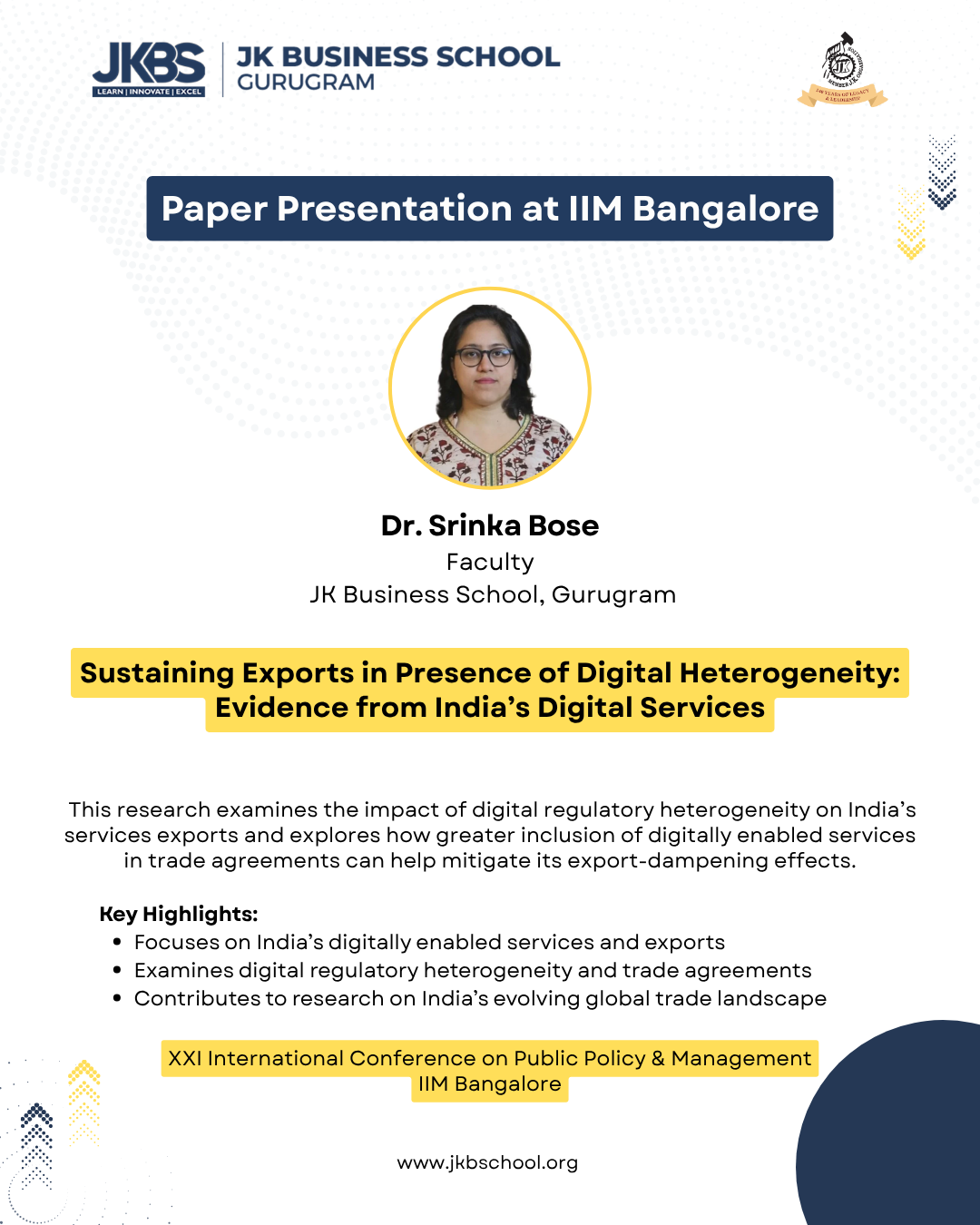
Contributing to this growing academic dialogue, Dr. Srinka Bose, Faculty at JK Business School, Gurugram, presented her research paper titled Sustaining Exports in Presence of Digital Heterogeneity: Evidence from India’s Digital Services at the XXI International Conference on Public Policy & Management at IIM Bangalore.
The research examines the impact of digital regulatory heterogeneity on India’s services exports and explores how trade agreements can contribute to strengthening digitally enabled services. By focusing on the relationship between regulation, trade and digital services, the study addresses an increasingly relevant dimension of India’s evolving position in the global economy.
The presentation at IIM Bangalore also reflects the continuing emphasis at JK Business School, Gurugram on faculty research that engages with contemporary economic, business and policy issues.
Understanding Digital Heterogeneity in Global Trade
Digital transformation has changed the way services are created, delivered and consumed across borders.
Many services that once required a physical presence can now be delivered through digital channels. This shift has expanded opportunities for international trade while creating a new set of regulatory considerations.
Different countries may follow different approaches to digital regulations. These differences can influence how businesses access markets and deliver services internationally.
This is where the idea of digital regulatory heterogeneity becomes particularly significant.
When regulatory environments differ across markets, firms participating in digitally enabled services may need to respond to multiple sets of requirements. Such differences can potentially affect the ease with which services are traded across borders.
Dr. Srinka Bose’s research examines this issue specifically in the context of India’s digital services exports, creating an important connection between academic research and a rapidly evolving area of international trade.
Why India’s Digital Services Exports Matter
India has an important position in the global services landscape, and the continued evolution of digital technologies is creating new ways for services to participate in international markets.
Digitally enabled services can cross geographical boundaries without always requiring the traditional physical movement associated with trade.
This creates significant possibilities, but it also means that regulations governing digital activity can influence trade outcomes.
For researchers, this raises important questions.
How do differences in digital regulations across countries affect services exports? Can international trade agreements help reduce some of the challenges created by regulatory differences? How can digitally enabled services remain competitive when operating across diverse regulatory environments?
The research presented by Dr. Bose engages with these questions through the context of India’s digital services.
Examining the Impact of Digital Regulatory Differences
A central focus of the paper is the impact of digital regulatory heterogeneity on services exports.
The growth of digital trade has created a business environment where technology allows services to move across borders quickly, but regulations may not always evolve in the same way across different economies.
As a result, digital connectivity alone may not be enough to ensure smooth international trade.
Businesses operating across markets also need to understand and respond to regulatory conditions.
This makes regulatory alignment and compatibility increasingly relevant to discussions around the future of digital trade.
By examining how regulatory differences relate to India’s export performance in digitally enabled services, the research adds an important policy dimension to the broader conversation around digital transformation.
The Role of Trade Agreements
Another significant aspect of the research is its focus on the role of trade agreements.
Trade agreements have traditionally addressed areas such as market access and the movement of goods and services. As economies become more digitally connected, the scope of international trade discussions is also evolving.
The research explores how greater inclusion of digitally enabled services within trade agreements can help mitigate the export-dampening effects associated with digital regulatory heterogeneity.
This is an important area for policymakers and businesses alike.
If differences in digital regulations create challenges for cross-border services, trade frameworks can potentially play a role in improving the environment in which digital services operate internationally.
For India, understanding this relationship can be valuable as the country continues to participate in global markets and expand its digitally enabled services ecosystem.
Connecting Digital Policy with Business
One of the most interesting aspects of digital trade research is that it sits at the intersection of multiple disciplines.
It is not solely a technology issue.
It is also about economics, business strategy, international trade and public policy.
A change in digital regulation in one market can influence the way businesses operate across borders. Trade agreements can affect opportunities available to service providers. Technological capabilities can determine how effectively companies participate in global digital markets.
For management students and researchers, this intersection creates a valuable area of study.
Understanding contemporary business increasingly requires an ability to examine not only what happens inside an organization but also the regulatory and economic environment in which that organization operates.
Research into digital trade provides exactly this broader perspective.
Why Research on Digital Trade Is Increasingly Relevant
Digitalisation is changing the structure of global commerce.
Businesses can reach customers across borders through technology. Professional services can be delivered remotely. Data and digital infrastructure have become closely connected with business operations.
At the same time, the regulatory environment surrounding digital activity continues to evolve.
This means the future of global trade will depend on more than technological capability. It will also depend on how countries approach regulation and how international frameworks respond to the realities of digitally enabled commerce.
Academic research can help make sense of these developments by identifying relationships, examining evidence and creating a stronger foundation for policy discussions.
The research presented by Dr. Srinka Bose contributes to this conversation by focusing specifically on the sustainability of exports in the presence of digital heterogeneity.
Representing JKBS at an Academic Platform
Presenting the research at the XXI International Conference on Public Policy & Management, IIM Bangalore provided an opportunity to take the work into a wider academic setting.
Academic conferences play an important role in the research ecosystem. They bring together researchers and scholars to present ideas, examine contemporary issues and contribute to discussions within their respective fields.
For faculty members, such platforms provide opportunities to engage with academic communities beyond their own institutions.
Dr. Bose’s presentation represents JK Business School, Gurugram in a research conversation that connects digital transformation with public policy and international trade.
It also reflects an approach to faculty scholarship that remains connected with developments shaping contemporary economies.
Research as Part of the Academic Environment at JKBS
Faculty research contributes to the academic environment of a business school in several ways.
It allows educators to remain engaged with developments in their disciplines. It creates opportunities to examine emerging questions in greater depth. Most importantly, it can bring contemporary perspectives into management education.
For students, learning from faculty members who actively participate in research can help connect classroom concepts with wider economic and business developments.
Topics such as digital trade, artificial intelligence, sustainability, business analytics, financial innovation and international business are evolving continuously. Management education must therefore engage with current developments rather than relying only on established frameworks.
At JK Business School, Gurugram, faculty research and academic participation contribute to this broader learning environment.
From Research to Classroom Conversations
The subject explored in this paper also has relevance across different areas of management education.
Students interested in international business can examine how regulations influence cross-border market opportunities.
Those studying business analytics can consider how evidence and data can help researchers understand complex trade patterns.
Students interested in digital transformation can explore how technological progress interacts with policy and regulation.
For those focused on strategy, the subject demonstrates why organizations operating internationally need to understand the regulatory environment of different markets.
This ability to connect one research question with multiple management disciplines demonstrates the value of contemporary academic research within a business school environment.
Contributing to the Dialogue on India’s Global Trade Landscape
India’s participation in the global digital economy presents both opportunities and questions that require continued study.
Digital technologies can expand the reach of services, but differences in regulatory frameworks can influence how effectively those opportunities are converted into sustainable exports.
The research paper Sustaining Exports in Presence of Digital Heterogeneity: Evidence from India’s Digital Services examines this relationship while also considering the potential role of trade agreements in strengthening digitally enabled services.
Through her presentation at the XXI International Conference on Public Policy & Management at IIM Bangalore, Dr. Srinka Bose contributed to a growing academic dialogue around digital trade, regulation and India’s evolving global trade landscape.
The presentation also adds to the continuing research engagement of faculty members at JK Business School, Gurugram, where academic inquiry extends beyond established business questions to emerging issues shaping markets, industries and economies.
As digitalisation continues to influence international commerce, research that examines the relationship between regulation and trade will remain increasingly relevant. Studies such as this help create a deeper understanding of the challenges and possibilities that accompany the growth of digitally enabled services and contribute to informed conversations about the future of global trade.